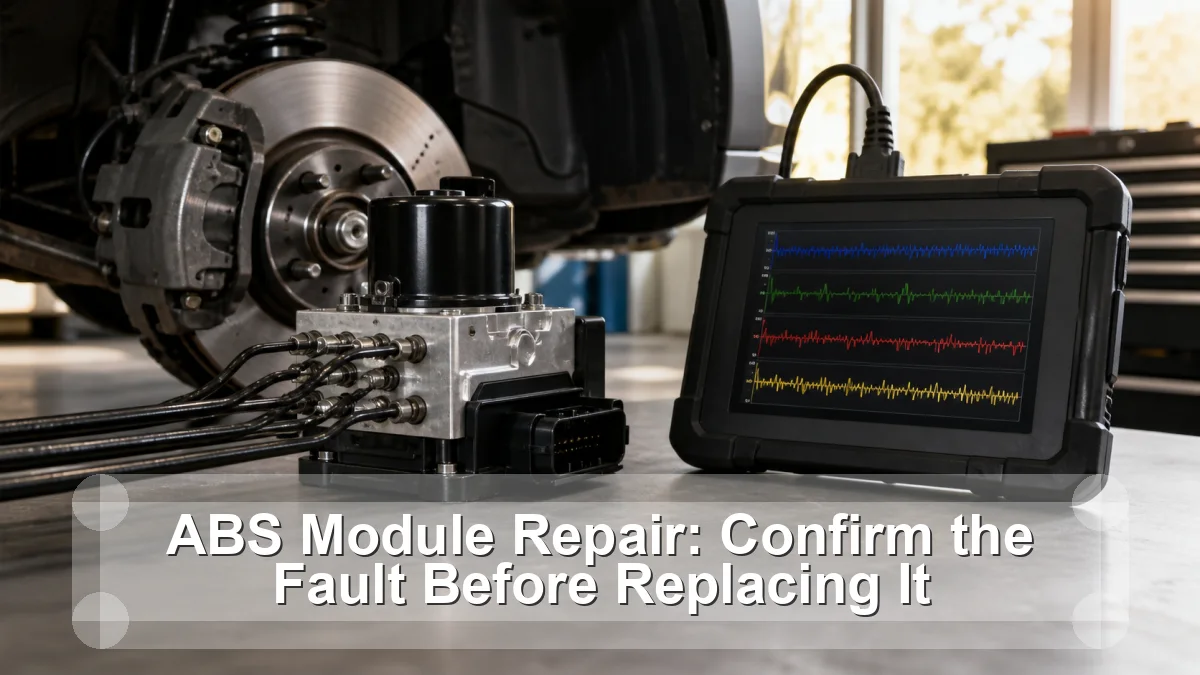
Do not condemn the ABS module from warning lights alone. Read chassis codes, verify battery voltage and grounds, inspect fuses and communication, compare live wheel-speed data, test sensor wiring and tone rings, and follow pump or valve tests. Module repair or replacement comes after inputs and power are proven.
This guide is a diagnosis and decision aid for a home-garage owner, not a claim that one symptom proves one failed part. Vehicle design, service limits, warning behavior, and test conditions vary, so the exact owner manual and service information remain the final authority.
What the clues actually tell you
The fastest useful move is to describe what changed, when it happens, and what does not happen. The table below is a triage card: it narrows the next check but deliberately avoids turning a clue into a verdict.
| What you notice | What it suggests | Best next move |
|---|---|---|
| One wheel-speed code and dropout | Sensor, ring, hub, or wiring likely | Module not first choice |
| No module communication | Power, ground, network, or module | Verify feeds before replacement |
| Internal-controller code returns | Module fault becomes stronger | Follow maker pinpoint test |
| Pump or valve code | Wiring, actuator, hydraulic unit, controller | Bi-directional test may be needed |
| Multiple lamps after low battery | Supply-voltage history possible | Charge and retest properly |
Use several matching clues. One reading, one noise, or one dashboard lamp can be affected by temperature, recent service, battery state, road conditions, or the way the vehicle’s control system is designed.
Work through the evidence in this order
- Start with safety and basics. If the red brake warning or pedal is abnormal, tow. Otherwise confirm fluid level, battery condition, charging, fuses, grounds, and recent wheel work.
- Use the right scanner. Generic engine-code readers may not access ABS. Record chassis codes, status, freeze-frame where available, module identification, and network faults.
- Validate sensor inputs. Compare live wheel speeds, inspect harness routing, connectors, tone rings, magnetic encoders, hub play, tire sizes, and contamination.
- Run pinpoint tests. Follow manufacturer checks for power, ground voltage drop, CAN communication, pump current, solenoid resistance or actuation, and internal fault codes.
- Choose a supported remedy. Rebuild, remanufacture, new, or used options have compatibility, VIN coding, immobilizer, programming, bleed, and calibration consequences. Verify warranty and return plan.
Write the observations down. A short record of conditions, readings, warning lamps, and recent work is more valuable to a technician than a replacement-part theory. If a test requires bypassing a safety system, opening a pressurized circuit, working near moving parts, or lifting beyond your equipment, stop at the observation stage.
Sensor-wiring-power-module proof checklist
The table and ordered checks above form the article’s working value object. To use it, circle the row that most closely matches the complaint, complete the next check, then revise the hypothesis. A result that contradicts the first guess is progress: it prevents a good component from being replaced and keeps the real fault visible.
Add three lines to the worksheet: conditions (cold, hot, wet, speed, load), evidence (measurement, code, wear, leak, sound), and decision (safe to monitor, book inspection, or stop and tow). That simple structure makes the diagnosis repeatable without pretending every vehicle shares one specification.
Common wrong turns
The tempting shortcut
An ABS lamp does not identify the module; sensors and wiring are common causes. A safe repair plan should explain both the failed condition and the evidence that ruled out its closest look-alikes.
The misleading assumption
Installing a used hydraulic unit without checking part number and coding can create a no-communication or unsafe brake problem. A safe repair plan should explain both the failed condition and the evidence that ruled out its closest look-alikes.
The incomplete repair
Opening hydraulic lines without the correct bleed procedure can leave air trapped in the modulator. A safe repair plan should explain both the failed condition and the evidence that ruled out its closest look-alikes.
When to stop
Tow for a red brake warning, changed pedal, fluid leak, unintended ABS activation, wheel lock, or reduced braking. ABS hydraulic service, coding, and active tests can command pumps and valves; use qualified tools and service information.
When the decision is “stop,” do not let schedule or convenience turn it back into “drive carefully.” Secure the vehicle away from traffic, use hazard warnings where appropriate, and arrange roadside or workshop help. Safety-critical faults can change faster than a symptom list suggests.
Related guides
- What Does the ABS Brake Light Mean?
- Wheel Bearing Noise: How to Separate It From Tire Noise
- How to Test a Car Battery With a Multimeter
These links are selected for the next safe decision rather than for keyword repetition. They cover the closest supporting check, tool, or workshop-safety step available before this article’s publication date.
Frequently asked questions
Can an ABS module be rebuilt?
Some electronic sections can be professionally rebuilt, but hydraulic damage, water intrusion, part design, coding, and safety verification determine suitability.
Will a used ABS module work?
It may require exact hardware and software matching, VIN coding, security setup, programming, bleeding, and calibrations. Some vehicles do not support reuse.
Can a bad wheel bearing set an ABS code?
Yes. Hub play, damaged encoder rings, rust, or an integrated sensor can distort wheel-speed signals and mimic electronic trouble.
Sources
- NHTSA: ABS function and malfunction-warning requirements
- ZF: ABS and ESC maintenance and diagnostic manual
Bottom line: Do not condemn the ABS module from warning lights alone. Read chassis codes, verify battery voltage and grounds, inspect fuses and communication, compare live wheel-speed data, test sensor wiring and tone rings, and follow pump or valve tests. Module repair or replacement comes after inputs and power are proven. Use the evidence path, respect the stop conditions, and confirm the exact repair against vehicle-specific information.