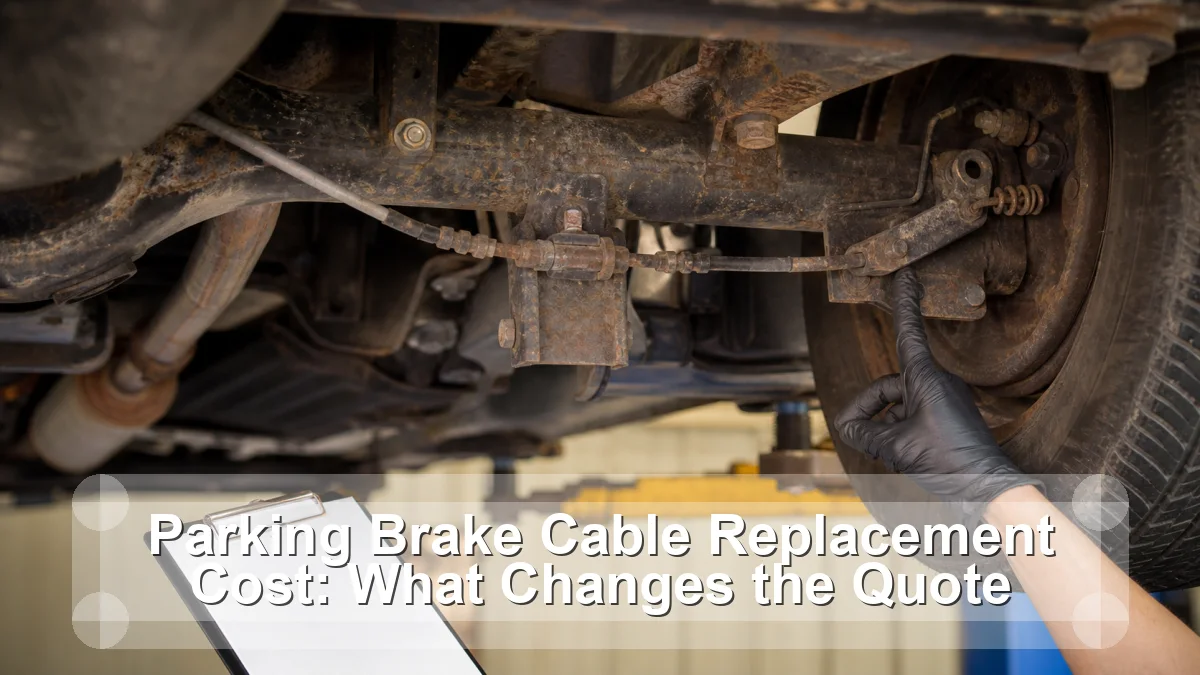
A mechanical parking-brake cable replacement commonly lands in the low hundreds, but the useful quote is vehicle-specific. Cable count, seized fasteners, exhaust or heat-shield removal, rear drum or caliper work, corrosion, adjustment, and diagnostic time can move the total substantially. An electronic parking brake may not use a serviceable cable at all.
This guide is a diagnosis and decision aid for a home-garage owner, not a claim that one symptom proves one failed part. Vehicle design, service limits, warning behavior, and test conditions vary, so the exact owner manual and service information remain the final authority.
What the clues actually tell you
The fastest useful move is to describe what changed, when it happens, and what does not happen. The table below is a triage card: it narrows the next check but deliberately avoids turning a clue into a verdict.
| What you notice | What it suggests | Best next move |
|---|---|---|
| Lever travel excessive but cables move | Adjustment or rear-brake wear | Cable may not be the only cause |
| Cable seized in housing | Replacement is likely | Inspect matching side and hardware |
| One rear wheel drags | Cable, lever, caliper, or shoe mechanism | Heat damage may add scope |
| No hold on incline | Stretch, break, adjustment, or brake wear | Inspect entire system |
| Electronic switch system | Actuator and scan procedure | Do not order a cable blindly |
Use several matching clues. One reading, one noise, or one dashboard lamp can be affected by temperature, recent service, battery state, road conditions, or the way the vehicle’s control system is designed.
Work through the evidence in this order
- Identify the architecture. Use the VIN and service information to map front, intermediate, left, right, equalizer, pedal or lever, and electronic actuator components.
- Confirm the failed part. Inspect cable travel, corrosion, housing damage, equalizer, rear levers, shoes or calipers, and adjustment before pricing.
- Read the labor scope. Exhaust, shields, seats, console, underbody panels, rusty clips, and rear brakes may need removal for access.
- Compare parts and warranty. Ask about cable brand, number of sections, hardware, corrosion protection, labor warranty, and whether paired replacement is recommended.
- Demand a functional finish. The quote should include adjustment, free release, wheel drag check, dashboard switch or lamp check, and a documented hold test under safe conditions.
Write the observations down. A short record of conditions, readings, warning lamps, and recent work is more valuable to a technician than a replacement-part theory. If a test requires bypassing a safety system, opening a pressurized circuit, working near moving parts, or lifting beyond your equipment, stop at the observation stage.
Estimate-line-item and scope comparison worksheet
The table and ordered checks above form the article’s working value object. To use it, circle the row that most closely matches the complaint, complete the next check, then revise the hypothesis. A result that contradicts the first guess is progress: it prevents a good component from being replaced and keeps the real fault visible.
Add three lines to the worksheet: conditions (cold, hot, wet, speed, load), evidence (measurement, code, wear, leak, sound), and decision (safe to monitor, book inspection, or stop and tow). That simple structure makes the diagnosis repeatable without pretending every vehicle shares one specification.
Common wrong turns
The tempting shortcut
Comparing a one-cable quote with a full-system quote creates a false bargain. A safe repair plan should explain both the failed condition and the evidence that ruled out its closest look-alikes.
The misleading assumption
Tightening adjustment to compensate for worn shoes can cause drag. A safe repair plan should explain both the failed condition and the evidence that ruled out its closest look-alikes.
The incomplete repair
Driving with a stuck cable overheats rear brakes and adds cost. A safe repair plan should explain both the failed condition and the evidence that ruled out its closest look-alikes.
When to stop
Do not rely on a parking brake that will not hold, and do not drive with a rear wheel dragging, smoking, or smelling hot. On an incline, use Park or the correct gear plus wheel chocks while arranging service; never work under a vehicle held only by the parking brake.
When the decision is “stop,” do not let schedule or convenience turn it back into “drive carefully.” Secure the vehicle away from traffic, use hazard warnings where appropriate, and arrange roadside or workshop help. Safety-critical faults can change faster than a symptom list suggests.
Related guides
- Brake Line Leak Repair: What a Safe Fix Actually Involves
- Stuck Brake Caliper Symptoms: Heat, Pulling, and Uneven Wear
- Floor Jack Safety Checklist
These links are selected for the next safe decision rather than for keyword repetition. They cover the closest supporting check, tool, or workshop-safety step available before this article’s publication date.
Frequently asked questions
What is a typical replacement price?
Many straightforward mechanical-cable jobs are quoted in the low hundreds, but access, cable count, corrosion, location, parts, and related brake work control the real number.
Do both cables need replacement?
Not universally. Matching age and corrosion may justify both sides, while some vehicles use multiple distinct sections. Inspect the whole system.
Can a parking brake cable be adjusted instead?
Adjustment helps only when components are intact and within specification. A seized, frayed, stretched beyond limit, or broken cable is replaced.
Sources
- California Bureau of Automotive Repair: brake inspection and diagnosis handbook
- RepairPal estimator: parking-brake activation switch and related estimate context
Bottom line: A mechanical parking-brake cable replacement commonly lands in the low hundreds, but the useful quote is vehicle-specific. Cable count, seized fasteners, exhaust or heat-shield removal, rear drum or caliper work, corrosion, adjustment, and diagnostic time can move the total substantially. An electronic parking brake may not use a serviceable cable at all. Use the evidence path, respect the stop conditions, and confirm the exact repair against vehicle-specific information.