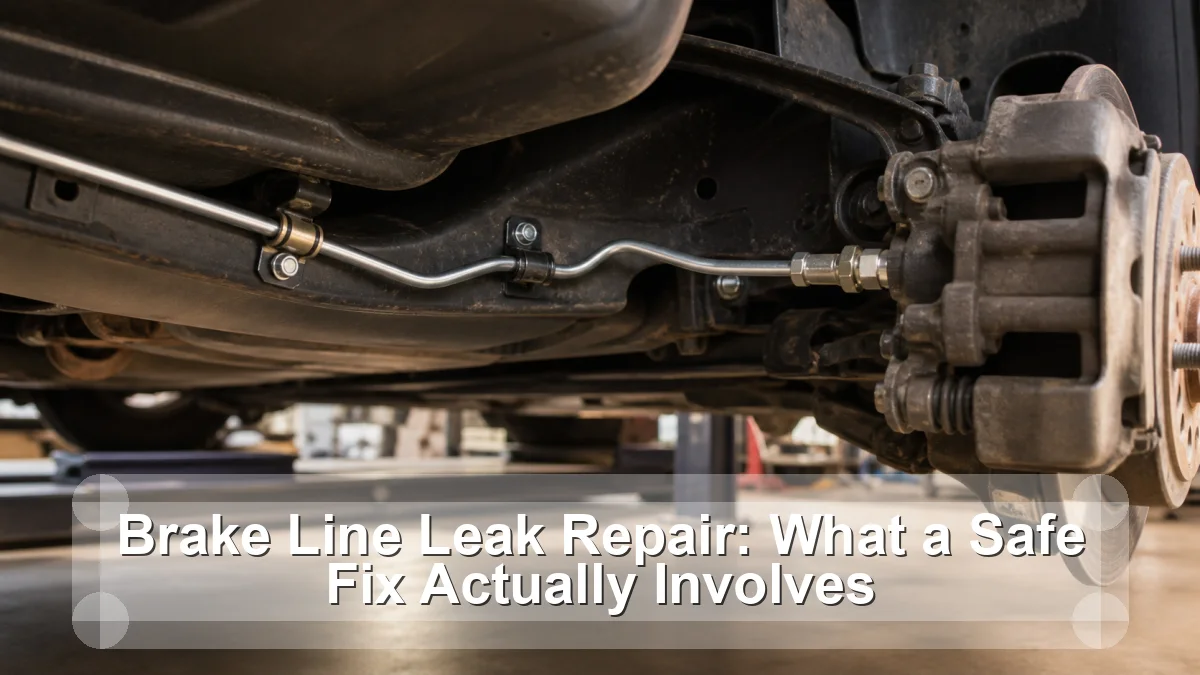
A leaking brake line is replaced with approved tubing, fittings, flare type, routing, protection, and unions for the exact vehicle—not sealed with tape, epoxy, stop-leak, or a casual compression fitting. The hydraulic system must then be filled, bled, leak-tested, and function-tested according to service information.
This guide is a diagnosis and decision aid for a home-garage owner, not a claim that one symptom proves one failed part. Vehicle design, service limits, warning behavior, and test conditions vary, so the exact owner manual and service information remain the final authority.
Read the pattern before choosing a part
The fastest useful move is to describe what changed, when it happens, and what does not happen. The table below is a triage card: it narrows the next check but deliberately avoids turning a clue into a verdict.
| What you notice | What it suggests | Best next move |
|---|---|---|
| Pin-hole in rusty steel line | Corrosion may extend beyond one spot | Inspect full run and parallel lines |
| Leak at flexible hose crimp | Hose assembly needs replacement | Check routing and twist |
| Wet fitting | Flare, seat, thread, or torque issue | Do not just overtighten |
| Line flattened by impact | Flow and strength compromised | Replace routed section or assembly |
| Leak near ABS unit | Port and hydraulic unit risk | Specialist procedure |
Use several matching clues. One reading, one noise, or one dashboard lamp can be affected by temperature, recent service, battery state, road conditions, or the way the vehicle’s control system is designed.
A practical check sequence
- Tow and clean for diagnosis. Move the vehicle without relying on compromised brakes. Clean only enough to locate the highest wet point and protect paint.
- Inspect system scope. Follow every visible line, flex hose, union, clip, shield, master cylinder, ABS unit, caliper, and wheel cylinder. Corrosion is often not isolated.
- Obtain exact repair information. Confirm material, diameter, flare standard, fitting threads, routing, bend radius, protective coating, clip positions, torque, and whether preformed lines are available.
- Install without shortcuts. Use approved brake-line tools and fittings, avoid kinks and contact with exhaust or moving parts, and replace damaged retainers and hoses.
- Bleed and verify. Use specified fluid and sequence, scan-tool ABS bleeding when required, pressure leak checks, pedal evaluation, wheel inspection, and controlled final verification.
Write the observations down. A short record of conditions, readings, warning lamps, and recent work is more valuable to a technician than a replacement-part theory. If a test requires bypassing a safety system, opening a pressurized circuit, working near moving parts, or lifting beyond your equipment, stop at the observation stage.
Line-versus-hose repair-scope checklist
The table and ordered checks above form the article’s working value object. To use it, circle the row that most closely matches the complaint, complete the next check, then revise the hypothesis. A result that contradicts the first guess is progress: it prevents a good component from being replaced and keeps the real fault visible.
Add three lines to the worksheet: conditions (cold, hot, wet, speed, load), evidence (measurement, code, wear, leak, sound), and decision (safe to monitor, book inspection, or stop and tow). That simple structure makes the diagnosis repeatable without pretending every vehicle shares one specification.
Common wrong turns
The tempting shortcut
Household compression fittings and plumbing tubing are not a safe brake-line repair. A safe repair plan should explain both the failed condition and the evidence that ruled out its closest look-alikes.
The misleading assumption
Cutting out only the visible pinhole can leave adjacent corrosion ready to fail. A safe repair plan should explain both the failed condition and the evidence that ruled out its closest look-alikes.
The incomplete repair
Overtightening a leaking flare can damage the seat and make the repair worse. A safe repair plan should explain both the failed condition and the evidence that ruled out its closest look-alikes.
When to stop
Do not drive the vehicle. Keep it secured on level ground and tow it. Brake fluid can damage paint and irritate eyes and skin. Fabricating and bleeding a critical hydraulic line is a skilled repair; stop if correct specifications, tools, support, or inspection access are unavailable.
When the decision is “stop,” do not let schedule or convenience turn it back into “drive carefully.” Secure the vehicle away from traffic, use hazard warnings where appropriate, and arrange roadside or workshop help. Safety-critical faults can change faster than a symptom list suggests.
Related guides
- Brake Fluid Leak? Find the Source and Stop Driving Safely
- Floor Jack Safety Checklist
- How to Find Your Car’s Jacking Points
These links are selected for the next safe decision rather than for keyword repetition. They cover the closest supporting check, tool, or workshop-safety step available before this article’s publication date.
Frequently asked questions
Can a brake line be patched?
A safe repair uses approved replacement line and fittings in a documented configuration. Tape, sealant, epoxy, hose clamps, and improvised compression fittings are not acceptable.
Should all brake lines be replaced?
Not automatically, but widespread corrosion, shared routing, age, and local inspection rules may make a larger replacement prudent.
Why is the pedal still soft after the leak is fixed?
Air, incomplete bleeding, another leak, internal bypass, hose expansion, or an ABS procedure may remain. Do not drive until the pedal and system pass verification.
Sources
- California Bureau of Automotive Repair: brake inspection and diagnosis handbook
- AutoZone: brake line and hose replacement overview
Bottom line: A leaking brake line is replaced with approved tubing, fittings, flare type, routing, protection, and unions for the exact vehicle—not sealed with tape, epoxy, stop-leak, or a casual compression fitting. The hydraulic system must then be filled, bled, leak-tested, and function-tested according to service information. Use the evidence path, respect the stop conditions, and confirm the exact repair against vehicle-specific information.