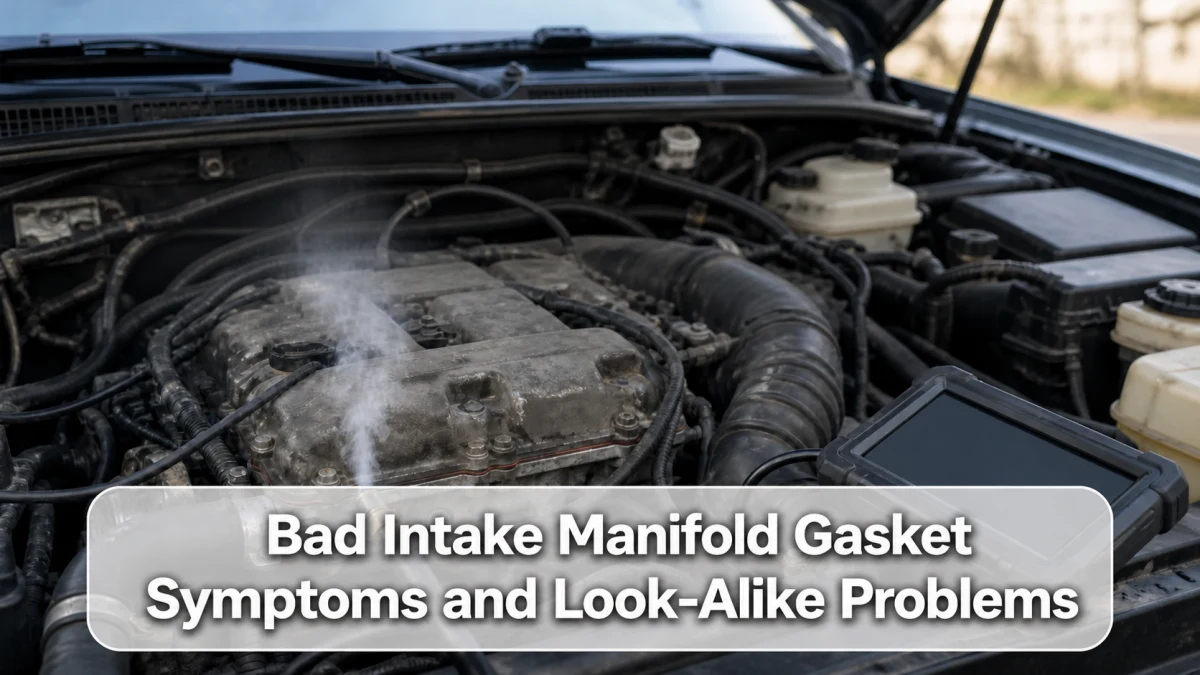
A bad intake manifold gasket can admit unmetered air, leak externally, or—on engines that route coolant through the manifold—lose coolant. Rough idle, lean codes, a hiss, coolant odor, or staining are clues, not proof. PCV, purge, injector, hose, throttle, head-gasket, and cooling-system faults can look similar.
What the gasket may seal
The intake manifold distributes air to the cylinders. Its gasket can seal individual intake ports, crankcase or vacuum passages, and on some engines coolant ports. Other designs use a dry manifold with no coolant connection. That architecture determines which symptoms are physically possible.
Obtain the engine code and current service diagram. Do not generalize a coolant-leak symptom from another engine that shares the same vehicle name.
Air-leak versus coolant-leak matrix
| Observation | Air-side gasket possibility | Coolant-side possibility |
|---|---|---|
| Rough idle that improves with speed | Unmetered air has greater effect at idle | Not the primary pattern unless cylinder is affected |
| Positive fuel trim on one bank | Leak near runners on that bank | Coolant path not established by trim |
| Hiss near manifold seam | Vacuum leak possible | Pressure leak may make different evidence |
| Dried coolant at manifold joint | Unrelated to air seal alone | External coolant passage leak possible |
| Coolant loss with no puddle | Not explained by a dry air leak | Internal or evaporating external path possible |
| Startup misfire after sitting | Air leak can affect mixture | Coolant entry is one serious possibility |
Air-leak pattern
Unmetered air entering after the airflow measurement can drive fuel trims positive and destabilize idle. Compare trims at warm idle and a steady higher speed under safe service conditions. A leak near one runner may affect one cylinder or bank more, while a shared vacuum source can influence the whole engine.
Lean codes do not name the gasket. A PCV valve stuck open, purge valve, brake-booster hose, intake duct, injector flow problem, low fuel pressure, exhaust leak, or biased sensor can create the same code family.
Coolant-leak pattern
On an engine with manifold coolant passages, inspect the joint for the highest fresh stain, especially around crossover sections. Coolant can collect in a valley, run behind the engine, land on a hot surface, or enter an intake port. Persistent white exhaust after warm-up, an unusually clean plug, startup misfire, or unexplained loss can justify internal testing.
Do not declare the gasket failed from one symptom. Use the hidden coolant-loss sequence to check heater, pump, reservoir, radiator, cooler, head-gasket, and other paths.
Look-alike checklist
- Cracked manifold, vacuum fitting, brake-booster hose, or intake duct
- PCV diaphragm, purge valve, throttle-body gasket, or injector seal
- Fuel pressure, injector flow, ignition, or compression fault
- Thermostat housing, coolant outlet, hose, pump, or head gasket
- Sensor wiring, mass-airflow contamination, or exhaust leak before an oxygen sensor
If the check engine light followed recent maintenance, use the post-service diagnostic checklist and inspect items actually disturbed without assuming the service caused the fault.
Role of smoke and pressure tests
A low-pressure smoke test can reveal an air leak when performed through the correct entry point at the manufacturer’s limit. Excess pressure can damage diaphragms and seals. Smoke escaping near a seam must be distinguished from a nearby hose or shaft.
A cooling-system pressure test can expose a coolant-side leak, but the correct cold pressure and adapter are vehicle-specific. Combustion-gas, cylinder leak-down, spark-plug, borescope, and oil tests may be added when an internal path is suspected. Interpret results together.
Repair planning
Manifold removal may disturb fuel rails, direct-injection pipes, coolant, wiring, and emissions hoses. Depressurization and high-pressure pipe rules must be followed. Keep debris out of open ports, inspect manifold flatness and cracks, and use the specified gasket orientation, sealant locations, bolt sequence, stages, and torque.
After assembly, refill and bleed coolant if required, inspect for fuel and coolant leaks before extended running, clear codes after preserving data, and verify trims and misfire counts through the prescribed drive cycle.
When not to drive
Stop for overheating, steam, rapid coolant loss, fuel odor, severe or flashing-light misfire, coolant-contaminated oil, or a large vacuum leak that makes control unsafe. Continuing can damage the engine or catalytic converter.
Frequently asked questions
Can an intake gasket leak only when cold?
Yes. Material contraction can expose a gap that changes as the engine warms. Record cold-start trims, misfires, and leakage before heat alters the evidence.
Will tightening the manifold bolts fix it?
Do not retighten blindly. Fasteners may be torque-to-yield, the gasket may be damaged, and extra torque can crack a plastic manifold or distort sealing surfaces.
Can a bad gasket cause high idle?
An air leak can raise or destabilize idle, but throttle, PCV, purge, control, and sensor faults require testing too.
Sources
- NHTSA-hosted bulletin: vehicle-specific intake manifold diagnosis example
- NHTSA-hosted manufacturer communication: intake system example
- Oards: intake manifold gasket symptom overview
Bottom line: first learn whether the gasket seals air, coolant, or both. Fuel-trim, smoke, pressure, and location evidence can separate a real manifold leak from the many systems that imitate one.