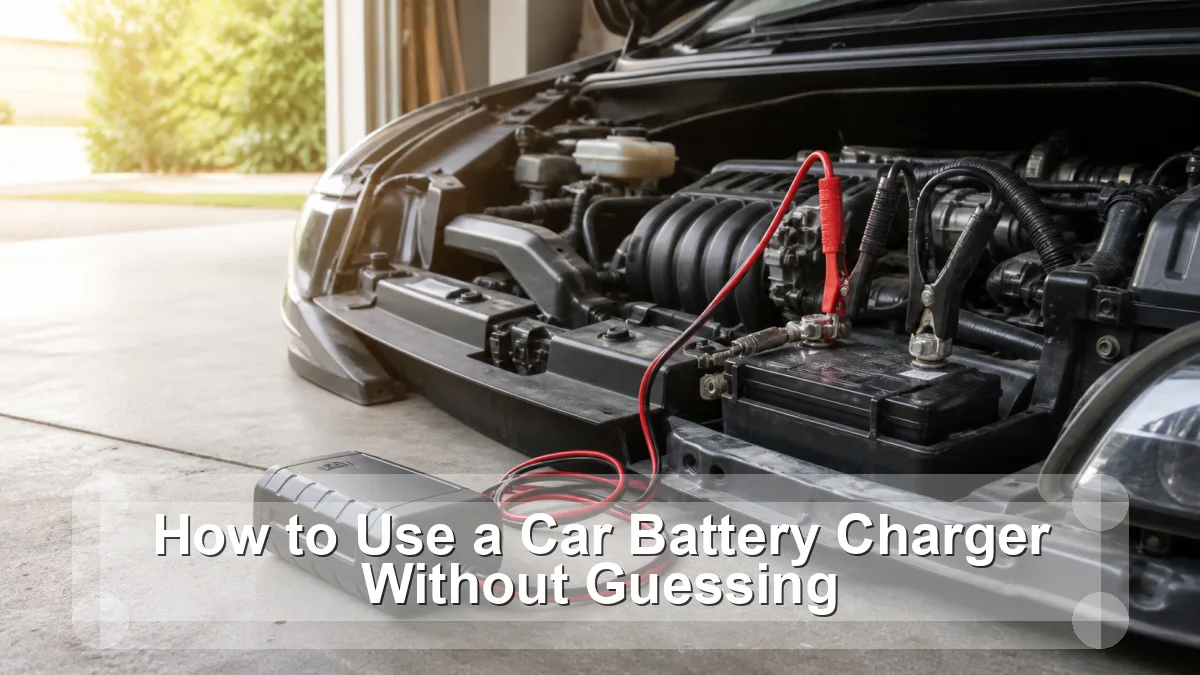
Match the charger to the battery voltage and chemistry, connect it while the charger is unplugged or switched off, then select the correct mode and let the charger finish according to its manual. The vehicle and charger manuals control whether the battery stays connected and which terminal or remote ground point to use.
This guide is a diagnosis and decision aid for a home-garage owner, not a claim that one symptom proves one failed part. Vehicle design, service limits, warning behavior, and test conditions vary, so the exact owner manual and service information remain the final authority.
What the clues actually tell you
The fastest useful move is to describe what changed, when it happens, and what does not happen. The table below is a triage card: it narrows the next check but deliberately avoids turning a clue into a verdict.
| What you notice | What it suggests | Best next move |
|---|---|---|
| AGM or other special chemistry label | Choose a compatible charger mode | Wrong settings can undercharge or damage |
| Battery is deeply discharged | Smart charger may not detect it | Follow charger manual; do not bypass safeguards blindly |
| Charger shows fault immediately | Polarity, connection, or battery issue | De-energize before correcting |
| Battery heats or vents strongly | Charging is not normal | Stop and move away |
| Charge completes but no-start returns | Battery capacity or parasitic drain may be poor | Diagnosis is still needed |
Use several matching clues. One reading, one noise, or one dashboard lamp can be affected by temperature, recent service, battery state, road conditions, or the way the vehicle’s control system is designed.
Work through the evidence in this order
- Read labels and manuals. Confirm 12-volt or other system voltage, flooded lead-acid, AGM, gel, lithium, or manufacturer-specific requirements. A charger safe for one chemistry is not automatically safe for another.
- Prepare the space. Use ventilation, keep flames and sparks away, remove jewelry, switch the vehicle off, and inspect the battery. Do not charge a cracked, swollen, leaking, or frozen unit.
- Place and connect. Set the charger on a stable surface away from the battery top. With AC power disconnected, attach positive as directed, then negative or the specified vehicle ground.
- Select the deliberate mode. Choose battery type and charge rate. Use repair, desulfation, supply, boost, or engine-start modes only when both the charger and vehicle instructions explicitly support them.
- Finish safely. Let an automatic charger indicate completion, then switch off or unplug AC before removing clamps in the directed order. Recheck battery behavior after surface charge settles.
Write the observations down. A short record of conditions, readings, warning lamps, and recent work is more valuable to a technician than a replacement-part theory. If a test requires bypassing a safety system, opening a pressurized circuit, working near moving parts, or lifting beyond your equipment, stop at the observation stage.
Charger-mode compatibility and connection checklist
The table and ordered checks above form the article’s working value object. To use it, circle the row that most closely matches the complaint, complete the next check, then revise the hypothesis. A result that contradicts the first guess is progress: it prevents a good component from being replaced and keeps the real fault visible.
Add three lines to the worksheet: conditions (cold, hot, wet, speed, load), evidence (measurement, code, wear, leak, sound), and decision (safe to monitor, book inspection, or stop and tow). That simple structure makes the diagnosis repeatable without pretending every vehicle shares one specification.
Common wrong turns
The tempting shortcut
Selecting a high-rate boost mode for convenience can be wrong for the battery and sensitive vehicle electronics. A safe repair plan should explain both the failed condition and the evidence that ruled out its closest look-alikes.
The misleading assumption
Charging in a closed garage concentrates gas and puts sparks too close to the battery. A safe repair plan should explain both the failed condition and the evidence that ruled out its closest look-alikes.
The incomplete repair
Assuming a completed charge proves the battery is healthy confuses charge acceptance with usable capacity. A safe repair plan should explain both the failed condition and the evidence that ruled out its closest look-alikes.
When to stop
Disconnect AC power and move away if the battery bulges, hisses, becomes unusually hot, leaks, or produces a strong sulfur odor. Do not charge a frozen battery. If the charger repeatedly faults, the battery will not accept a charge, or the vehicle has high-voltage hybrid or EV warnings, use qualified service.
When the decision is “stop,” do not let schedule or convenience turn it back into “drive carefully.” Secure the vehicle away from traffic, use hazard warnings where appropriate, and arrange roadside or workshop help. Safety-critical faults can change faster than a symptom list suggests.
Related guides
- How to Test a Car Battery With a Multimeter
- How to Use Jumper Cables Safely: Connection and Removal Order
- How to Check an Alternator: A Battery-to-Charging-System Test
These links are selected for the next safe decision rather than for keyword repetition. They cover the closest supporting check, tool, or workshop-safety step available before this article’s publication date.
Frequently asked questions
Should the battery be disconnected from the car?
It depends on the vehicle and charger. The manuals may specify in-vehicle remote posts, negative-terminal disconnection, memory procedures, or voltage limits.
How long does charging take?
Battery capacity, state of charge, temperature, charger output, and charging phase all matter. Use the charger display and manual instead of a universal hour estimate.
Is a maintainer the same as a charger?
A maintainer is intended for long-term support at a low controlled rate; some devices do both jobs. Confirm the mode, chemistry support, and unattended-use instructions.
Sources
- AAA: charging a car battery safely and choosing a charger
- Fluke: measuring automotive battery voltage with a multimeter
Bottom line: Match the charger to the battery voltage and chemistry, connect it while the charger is unplugged or switched off, then select the correct mode and let the charger finish according to its manual. The vehicle and charger manuals control whether the battery stays connected and which terminal or remote ground point to use. Use the evidence path, respect the stop conditions, and confirm the exact repair against vehicle-specific information.