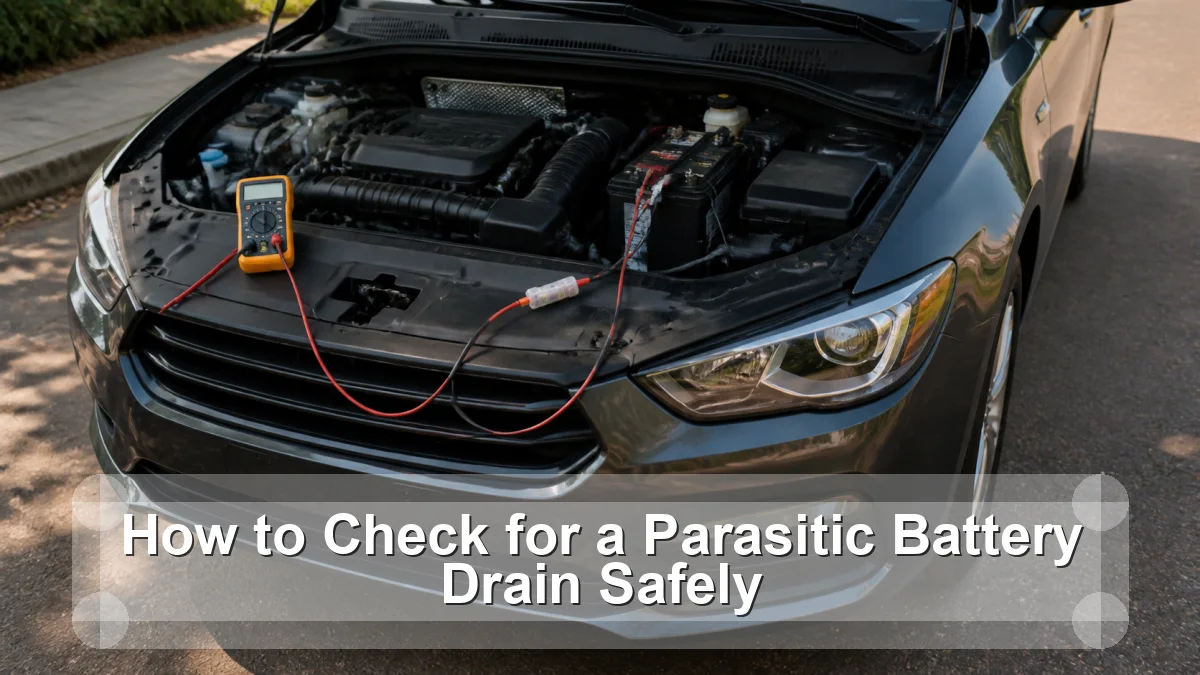
Before measuring key-off current, fully charge and test the battery, confirm the charging system, close or latch every monitored opening, move the key away, and let the vehicle enter sleep mode. Modern vehicles can wake modules easily, and a meter connected incorrectly in series can blow its fuse or create a hazardous arc.
This guide is a diagnosis and decision aid for a home-garage owner, not a claim that one symptom proves one failed part. Vehicle design, service limits, warning behavior, and test conditions vary, so the exact owner manual and service information remain the final authority.
What the clues actually tell you
The fastest useful move is to describe what changed, when it happens, and what does not happen. The table below is a triage card: it narrows the next check but deliberately avoids turning a clue into a verdict.
| What you notice | What it suggests | Best next move |
|---|---|---|
| Battery dies only after several days | Small sustained draw or weak capacity | Timing helps estimate the problem |
| Battery dies overnight | Large draw or poor battery is possible | Look for lamps, relays, accessories |
| Draw falls in steps | Modules are going to sleep | Wait for stable baseline |
| Opening a door changes the reading | Vehicle woke normally | Restart the sleep period |
| One fuse changes the draw | Circuit is identified, not the failed part | Use its diagram and branches |
Use several matching clues. One reading, one noise, or one dashboard lamp can be affected by temperature, recent service, battery state, road conditions, or the way the vehicle’s control system is designed.
Work through the evidence in this order
- Prove the complaint. Charge and capacity-test the battery, check charging response, clean connections, and record battery voltage over a known parking period. Replacement batteries can also be weak or undercharged.
- Find obvious loads. Check glove-box, vanity, cargo, and under-hood lamps, stuck relays, plugged-in adapters, dash cameras, trackers, alarms, chargers, and recent accessory work.
- Prepare sleep conditions. Follow service information for hood and door latches, locked state, key distance, telematics, and wait time. Keep a bypass lead if the procedure requires preserving continuity while installing the meter.
- Measure without overloading. Use the correct fused current input and begin on the highest supported range. Never crank, switch on high loads, or open a door with a low-range meter in series. Fuse voltage-drop testing may be safer on complex vehicles.
- Trace the circuit. Once excessive draw is confirmed and stable, identify the affected fuse or branch. Then use the wiring diagram to separate modules, relays, lamps, wiring, and normal keep-alive loads.
Write the observations down. A short record of conditions, readings, warning lamps, and recent work is more valuable to a technician than a replacement-part theory. If a test requires bypassing a safety system, opening a pressurized circuit, working near moving parts, or lifting beyond your equipment, stop at the observation stage.
Sleep-state and fuse-circuit isolation worksheet
The table and ordered checks above form the article’s working value object. To use it, circle the row that most closely matches the complaint, complete the next check, then revise the hypothesis. A result that contradicts the first guess is progress: it prevents a good component from being replaced and keeps the real fault visible.
Add three lines to the worksheet: conditions (cold, hot, wet, speed, load), evidence (measurement, code, wear, leak, sound), and decision (safe to monitor, book inspection, or stop and tow). That simple structure makes the diagnosis repeatable without pretending every vehicle shares one specification.
Common wrong turns
The tempting shortcut
Pulling fuses before modules sleep can create false changes and new stored faults. A safe repair plan should explain both the failed condition and the evidence that ruled out its closest look-alikes.
The misleading assumption
Placing an ammeter directly across battery posts creates a short, not a parasitic-draw test. A safe repair plan should explain both the failed condition and the evidence that ruled out its closest look-alikes.
The incomplete repair
Naming a module as failed because its fuse reduced current ignores every other load on that circuit. A safe repair plan should explain both the failed condition and the evidence that ruled out its closest look-alikes.
When to stop
Stop if the meter lead, battery cable, or connection heats; if arcing continues; if the meter fuse opens repeatedly; or if service information requires module programming or high-voltage precautions. Do not perform an in-series test if you cannot prevent the vehicle from waking or if someone may try to start it.
When the decision is “stop,” do not let schedule or convenience turn it back into “drive carefully.” Secure the vehicle away from traffic, use hazard warnings where appropriate, and arrange roadside or workshop help. Safety-critical faults can change faster than a symptom list suggests.
Related guides
- How to Test a Car Battery With a Multimeter
- How to Check an Alternator: A Battery-to-Charging-System Test
- Bad Starter Relay Symptoms and Simple Confirmation Checks
These links are selected for the next safe decision rather than for keyword repetition. They cover the closest supporting check, tool, or workshop-safety step available before this article’s publication date.
Frequently asked questions
How much parasitic draw is normal?
There is no safe universal number for every vehicle. Module count, telematics, alarms, sleep time, and battery capacity vary; use model-specific specifications.
Why did the reading jump when I opened the door?
Interior lights and body modules woke up. That is normal behavior and means the sleep timer must usually start again.
Can the alternator drain a battery while parked?
A failed diode can create key-off draw, but confirm it with the correct test before disconnecting the alternator circuit.
Sources
- Fluke: finding a parasitic battery drain with a multimeter
- Fluke: measuring automotive battery voltage with a multimeter
Bottom line: Before measuring key-off current, fully charge and test the battery, confirm the charging system, close or latch every monitored opening, move the key away, and let the vehicle enter sleep mode. Modern vehicles can wake modules easily, and a meter connected incorrectly in series can blow its fuse or create a hazardous arc. Use the evidence path, respect the stop conditions, and confirm the exact repair against vehicle-specific information.