A car that fires and dies has passed the basic cranking test, so focus on what disappears after startup: fuel pressure, injector authorization, ignition, metered airflow, idle control, or exhaust flow. The exact timing matters. A one- or two-second shutdown with a flashing security lamp points in a different direction from a warm engine that stalls only when the throttle closes.
This guide is a diagnosis and decision aid for a home-garage owner, not a claim that one symptom proves one failed part. Vehicle design, service limits, warning behavior, and test conditions vary, so the exact owner manual and service information remain the final authority.
Use timing and condition as evidence
The fastest useful move is to describe what changed, when it happens, and what does not happen. The table below is a triage card: it narrows the next check but deliberately avoids turning a clue into a verdict.
| What you notice | What it suggests | Best next move |
|---|---|---|
| Dies in one or two seconds with security lamp | Immobilizer authorization is suspect | Use key and security diagnostics |
| Runs only with throttle held slightly open | Idle air, throttle, or large vacuum leak | Do not keep racing the engine |
| Dies as fuel pressure falls | Pump, power, control, or restriction | Measure to specification |
| Stalls after recent air-filter work | Intake duct or sensor may be disturbed | Inspect before buying parts |
| Dies hot but restarts cold | Heat-sensitive electrical or fuel fault | Capture data during failure |
Use several matching clues. One reading, one noise, or one dashboard lamp can be affected by temperature, recent service, battery state, road conditions, or the way the vehicle’s control system is designed.
The no-parts-darts diagnostic path
- Describe the event. Separate starts-and-dies from no-crank, cranks-but-never-fires, and stalls while driving. Note cold or hot, exact run time, throttle response, weather, fuel level, and recent repairs.
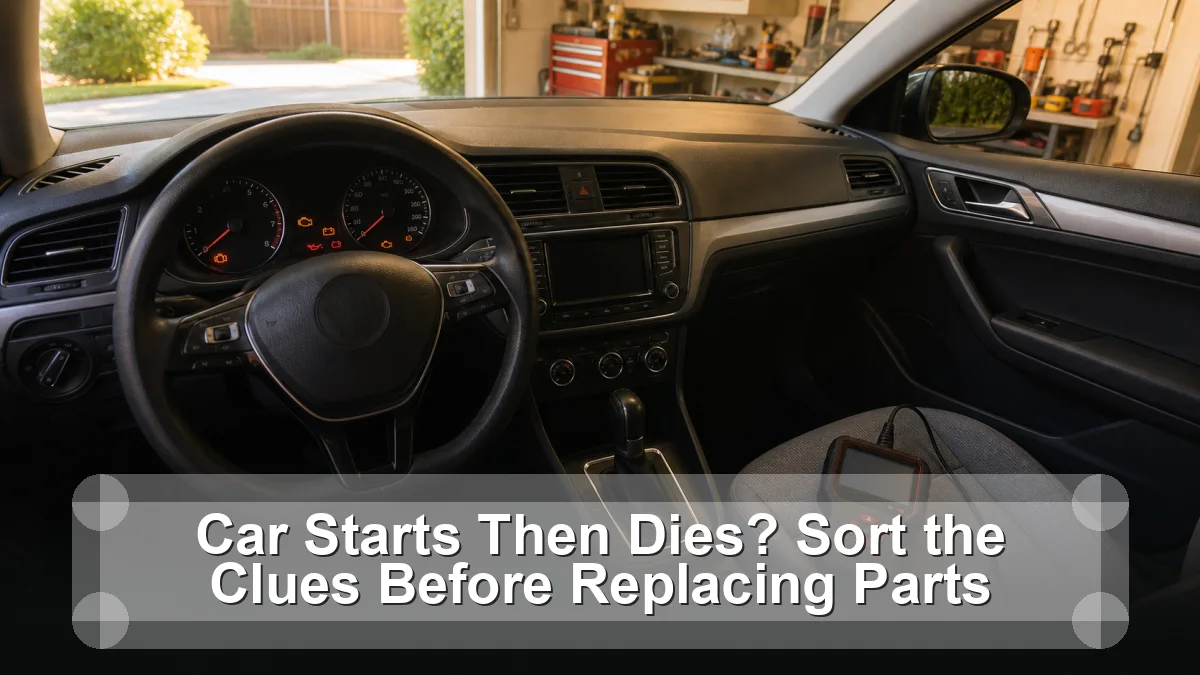
- Read the dashboard. A security indicator, warning message, or unusual lamp sequence can identify authorization or power-supply trouble. Do not ignore a red oil-pressure or temperature warning.
- Inspect the simple disturbances. Check that intake boots, mass-airflow connectors, vacuum hoses, battery terminals, grounds, and fuel cap area were not left loose after maintenance.
- Scan without parts darts. Retrieve powertrain, body, and anti-theft codes when accessible. Watch engine speed, throttle angle, airflow, fuel trims, pressure, and authorization status during the brief run.
- Test the likely system. Use manufacturer procedures for fuel pressure, spark, injector command, immobilizer, idle adaptation, and exhaust restriction. One symptom list cannot replace measured evidence.
Write the observations down. A short record of conditions, readings, warning lamps, and recent work is more valuable to a technician than a replacement-part theory. If a test requires bypassing a safety system, opening a pressurized circuit, working near moving parts, or lifting beyond your equipment, stop at the observation stage.
Stall-timing and dashboard-clue decision matrix
The table and ordered checks above form the article’s working value object. To use it, circle the row that most closely matches the complaint, complete the next check, then revise the hypothesis. A result that contradicts the first guess is progress: it prevents a good component from being replaced and keeps the real fault visible.
Add three lines to the worksheet: conditions (cold, hot, wet, speed, load), evidence (measurement, code, wear, leak, sound), and decision (safe to monitor, book inspection, or stop and tow). That simple structure makes the diagnosis repeatable without pretending every vehicle shares one specification.
Common wrong turns
The tempting shortcut
Replacing the battery because the engine stopped ignores that it already cranked and fired. A safe repair plan should explain both the failed condition and the evidence that ruled out its closest look-alikes.
The misleading assumption
Holding the throttle wide open repeatedly can mask the pattern and create a new safety problem. A safe repair plan should explain both the failed condition and the evidence that ruled out its closest look-alikes.
The incomplete repair
Clearing codes before recording freeze-frame and status data erases useful evidence. A safe repair plan should explain both the failed condition and the evidence that ruled out its closest look-alikes.
When to stop
Stop trying to run the engine if there is fuel odor, smoke, a red oil-pressure or temperature warning, mechanical knocking, backfire, a glowing exhaust component, or repeated starter engagement. If the car also stalls while driving, do not rely on it in traffic; arrange diagnosis and towing.
When the decision is “stop,” do not let schedule or convenience turn it back into “drive carefully.” Secure the vehicle away from traffic, use hazard warnings where appropriate, and arrange roadside or workshop help. Safety-critical faults can change faster than a symptom list suggests.
Related guides
- Bad Starter Motor Symptoms: Battery, Relay, or Starter?
- Bad Intake Manifold Gasket Symptoms
- PCV Valve Stuck Open Symptoms
These links are selected for the next safe decision rather than for keyword repetition. They cover the closest supporting check, tool, or workshop-safety step available before this article’s publication date.
Frequently asked questions
Can a bad battery make a car start and then die?
Low system voltage can disrupt modules, but once the engine fires the charging and power-distribution systems also matter. Test rather than assuming the battery is the sole cause.
Why does it run when I press the gas?
That clue can point toward idle airflow, throttle deposits or adaptation, a large intake leak, or an overly rich condition. It does not name one part.
Will an OBD scanner always find the cause?
No. Codes and live data narrow the path, but fuel pressure, power, grounds, mechanical condition, or an anti-theft fault may require additional tools and service information.
Sources
- HELLA Tech World: starting-system diagnosis and starter checks
- NHTSA-hosted Ford technical service bulletin: model-specific hard-start/no-start after refueling example
Bottom line: A car that fires and dies has passed the basic cranking test, so focus on what disappears after startup: fuel pressure, injector authorization, ignition, metered airflow, idle control, or exhaust flow. The exact timing matters. A one- or two-second shutdown with a flashing security lamp points in a different direction from a warm engine that stalls only when the throttle closes. Use the evidence path, respect the stop conditions, and confirm the exact repair against vehicle-specific information.