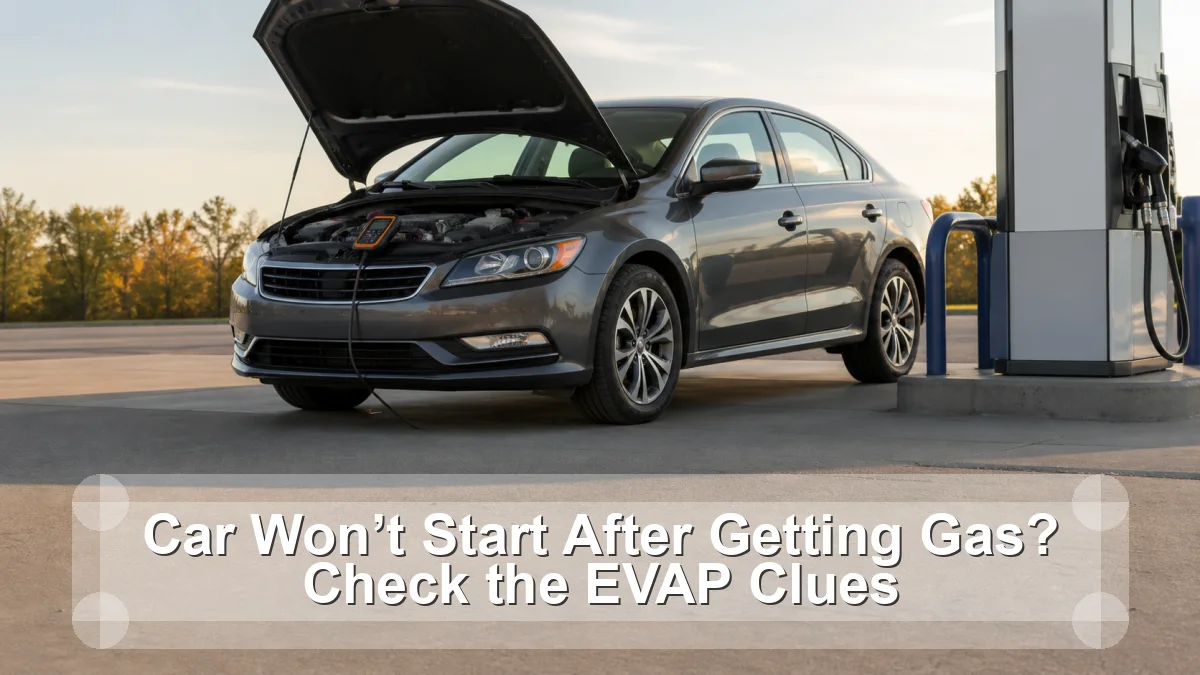
If the engine cranks normally but becomes hard to start only after refueling, a purge valve that leaks vapor into the intake is a strong clue—not a universal verdict. First separate cranks-but-will-not-start from no-crank, note whether the tank was topped off, watch for fuel odor or rough running, and scan for EVAP or rich-mixture evidence.
This guide is a diagnosis and decision aid for a home-garage owner, not a claim that one symptom proves one failed part. Vehicle design, service limits, warning behavior, and test conditions vary, so the exact owner manual and service information remain the final authority.
Read the pattern before choosing a part
The fastest useful move is to describe what changed, when it happens, and what does not happen. The table below is a triage card: it narrows the next check but deliberately avoids turning a clue into a verdict.
| What you notice | What it suggests | Best next move |
|---|---|---|
| Cranks normally but starts hard only after filling | EVAP purge leak fits the timing | Confirm with valve and scan tests |
| No crank or only clicking | Battery or starting circuit first | Refueling may be coincidental |
| Rough start plus strong fuel odor | Rich vapor or fuel condition | Avoid repeated cranking |
| Problem began after topping off | Canister may be saturated | Stop adding fuel after automatic shutoff |
| Several vehicles affected from same pump | Fuel contamination becomes plausible | Keep receipt and report promptly |
Use several matching clues. One reading, one noise, or one dashboard lamp can be affected by temperature, recent service, battery state, road conditions, or the way the vehicle’s control system is designed.
A practical check sequence
- Classify the no-start. Listen for normal cranking. A purge-related rich start usually still cranks; a silent or slow starter sends the diagnosis back to battery, cable, relay, or motor.
- Make the scene safe. If fuel is visibly leaking, odor is intense, or smoke appears, stop and move away. Do not create sparks, smoke, or keep cranking near a suspected fuel leak.
- Record the refueling pattern. Note tank level, amount added, automatic nozzle shutoff, whether the tank was topped off, fuel station and pump, weather, and whether the fault repeats after every fill.
- Check EVAP evidence. Retrieve codes and data. A technician can test whether the purge valve seals when commanded closed, inspect hoses and canister, and compare the result with manufacturer bulletins for the exact vehicle.
- Keep alternatives open. Weak battery, failing pump, electrical power loss, contaminated fuel, sensor faults, or an unrelated hot-start condition can coincide with a fuel stop. Test the condition that matches the evidence.
Write the observations down. A short record of conditions, readings, warning lamps, and recent work is more valuable to a technician than a replacement-part theory. If a test requires bypassing a safety system, opening a pressurized circuit, working near moving parts, or lifting beyond your equipment, stop at the observation stage.
Post-refueling symptom and EVAP evidence card
The table and ordered checks above form the article’s working value object. To use it, circle the row that most closely matches the complaint, complete the next check, then revise the hypothesis. A result that contradicts the first guess is progress: it prevents a good component from being replaced and keeps the real fault visible.
Add three lines to the worksheet: conditions (cold, hot, wet, speed, load), evidence (measurement, code, wear, leak, sound), and decision (safe to monitor, book inspection, or stop and tow). That simple structure makes the diagnosis repeatable without pretending every vehicle shares one specification.
Common wrong turns
The tempting shortcut
Replacing a gas cap for a cranks-no-start rarely addresses a purge valve leaking directly into the intake. A safe repair plan should explain both the failed condition and the evidence that ruled out its closest look-alikes.
The misleading assumption
Continuing to top off after the nozzle clicks can saturate the vapor-recovery system. A safe repair plan should explain both the failed condition and the evidence that ruled out its closest look-alikes.
The incomplete repair
Assuming every post-fill no-start is EVAP ignores contaminated fuel and starting-circuit faults. A safe repair plan should explain both the failed condition and the evidence that ruled out its closest look-alikes.
When to stop
Tow the vehicle for visible fuel, a strong persistent raw-fuel odor, smoke, fire risk, severe rough running, repeated stalling in traffic, contaminated-fuel evidence, or a no-crank with hot cables. Avoid repeated long cranking because unburned fuel can damage the catalytic converter and dilute engine oil.
When the decision is “stop,” do not let schedule or convenience turn it back into “drive carefully.” Secure the vehicle away from traffic, use hazard warnings where appropriate, and arrange roadside or workshop help. Safety-critical faults can change faster than a symptom list suggests.
Related guides
- Car Starts Then Dies? Sort the Clues Before Replacing Parts
- Fuel Injector Leak Symptoms
- Check Engine Light After an Oil Change?
These links are selected for the next safe decision rather than for keyword repetition. They cover the closest supporting check, tool, or workshop-safety step available before this article’s publication date.
Frequently asked questions
Why does a purge valve affect starting after refueling?
A valve that does not seal can allow an excessive vapor charge into the intake while the tank is being filled, creating an overly rich start on affected systems.
Will loosening the gas cap fix it?
Usually not. The cap and purge valve have different jobs. A cap may set leak codes, while a valve leaking into the intake creates a different path.
Can bad gasoline cause the same symptom?
Yes. Contamination can cause hard starting, rough running, misfire, or stalling. Timing across multiple customers, the receipt, fuel sample procedures, and diagnostics help separate it.
Sources
- NHTSA-hosted Ford technical service bulletin: model-specific hard-start/no-start after refueling example
- U.S. EPA: vehicle refueling emissions and onboard vapor-recovery context
Bottom line: If the engine cranks normally but becomes hard to start only after refueling, a purge valve that leaks vapor into the intake is a strong clue—not a universal verdict. First separate cranks-but-will-not-start from no-crank, note whether the tank was topped off, watch for fuel odor or rough running, and scan for EVAP or rich-mixture evidence. Use the evidence path, respect the stop conditions, and confirm the exact repair against vehicle-specific information.