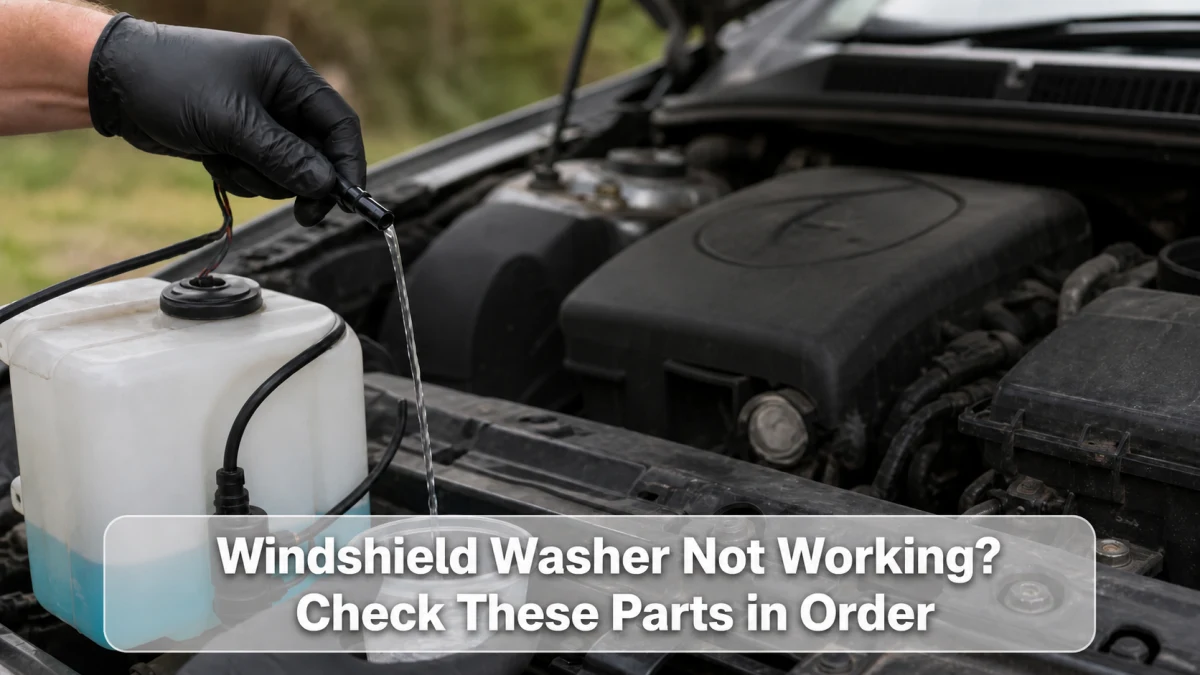
When windshield washers stop, first protect visibility, confirm the reservoir contains the correct seasonal fluid, and listen for the pump. Pump sound with no spray points toward frozen, disconnected, leaking, blocked, or misdirected plumbing. Silence points toward fluid freezing around the pump, a fuse, power, ground, switch command, wiring, or the pump itself.
No-spray sound and flow decision tree
| What happens | Likely direction | Next check |
|---|---|---|
| Pump hums; no nozzle sprays | Empty/frozen reservoir, disconnected hose, blockage | Inspect tank, hose routing, and leakage |
| Pump hums; fluid pours under car | Split hose, failed fitting, cracked tank | Trace the highest wet point |
| One nozzle sprays; one does not | Blocked nozzle or branch hose | Disconnect and test flow per service procedure |
| Weak spray from all nozzles | Low fluid, restriction, weak pump, leak, low voltage | Check supply and flow path |
| No pump sound | Fuse, command, wiring, ground, frozen or failed pump | Electrical test at the pump |
| Front works; rear fails | Separate pump/output, long hose, check valve, rear nozzle | Use the vehicle’s circuit and hose map |
Check fluid and freezing first
Washer fluid is sold for different freeze protection. Water or warm-weather mixture can freeze in the tank, pump, hose, or nozzle. Move the vehicle to a safely heated space and let the system thaw naturally. Do not pour boiling water on glass or tank, apply an open flame, or hold the switch while the pump is frozen.
Once thawed, drain or dilute only according to product and vehicle guidance, then fill with compatible seasonal fluid. Mixing products can reduce claimed freeze performance.
Listen without overworking the pump
With ignition state set as the owner’s manual directs, operate the washer for one brief pulse while another person listens near the reservoir from a safe position. Keep everyone clear of wipers, belts, fans, and hot parts. Some systems run the wipers automatically, so hands must stay away from the mechanism.
If the wipers also fail, use the wiper behavior diagnostic table because a shared switch or control issue may be involved.
Trace the hose and nozzles
- Fill to the correct level and inspect the reservoir for cracks or wet seams.
- Follow accessible hoses for disconnection, pinching, chafing, and sharp bends.
- Check hood-hinge and tailgate flex points where hoses repeatedly move.
- Operate briefly and watch for fluid inside the cowl, hood liner, cabin edge, or tailgate trim.
- Disconnect sections only as service information permits; brittle fittings break easily.
- Confirm flow before the nozzle to separate a nozzle restriction from an upstream fault.
A fine non-damaging tool or compressed air is sometimes recommended for specific nozzles, but forcing a metal pin can enlarge or mis-aim the jet, and excessive air pressure can separate hidden hoses. Follow the manufacturer’s cleaning or replacement method.
Check recent work and seasonal clues
Note whether failure began after hood, cowl, windshield, fender, or tailgate work. A hose may be pinched beneath trim or left disconnected. If the problem arrived with the first freeze, inspect fluid rating and allow a complete thaw before electrical diagnosis. Photograph leaks and hose routing before moving parts; that preserves evidence and makes an intermittent disconnect easier to explain.
Electrical checks when the pump is silent
Locate the fuse from current owner or service information and test both sides electrically. If it opens again, do not fit a larger fuse; locate the short or overload. At the pump connector, check voltage, ground, and command under load using the correct pinout. A meter showing voltage with the connector unplugged may miss a high-resistance circuit.
Many washer switches report through a body-control module rather than carrying pump current directly. Scan body codes and switch input where supported. Do not disassemble steering-column components near airbags without the required restraint-system procedure.
Repair and final aim
Replace the confirmed pump, hose, connector, check valve, reservoir, or nozzle with a compatible part. Route hoses away from hinges and hot or sharp surfaces. Test for leaks, then adjust nozzle aim only by the approved method so spray covers the glass without distracting other road users.
Keep suitable washer fluid and visibility supplies from the car emergency checklist, especially before freezing weather or a long trip.
Frequently asked questions
Can I put dish soap in the washer tank?
Do not improvise. Household detergents can foam, freeze, attack materials, or leave visibility-reducing film. Use fluid approved for automotive washer systems and local conditions.
Why does the pump run but spray is delayed?
A leaking check valve, draining hose, air leak, restriction, or weak pump may delay pressure. Inspect the path and use the model’s flow test.
Can a blocked nozzle burn out the pump?
Repeated prolonged operation against a restriction can overheat some pumps. Use brief tests and correct the blockage.
Sources
- Honda owner’s manual: windshield washer operation and precautions
- Samarins: washer system diagnostic sequence
Bottom line: pump sound divides the diagnosis. Follow fluid from tank to nozzle when it runs; verify fuse, command, power, and ground when it does not.