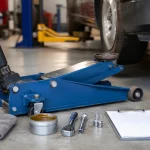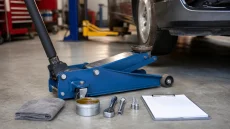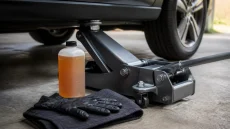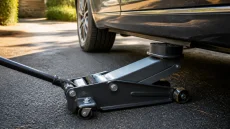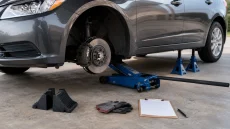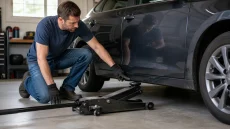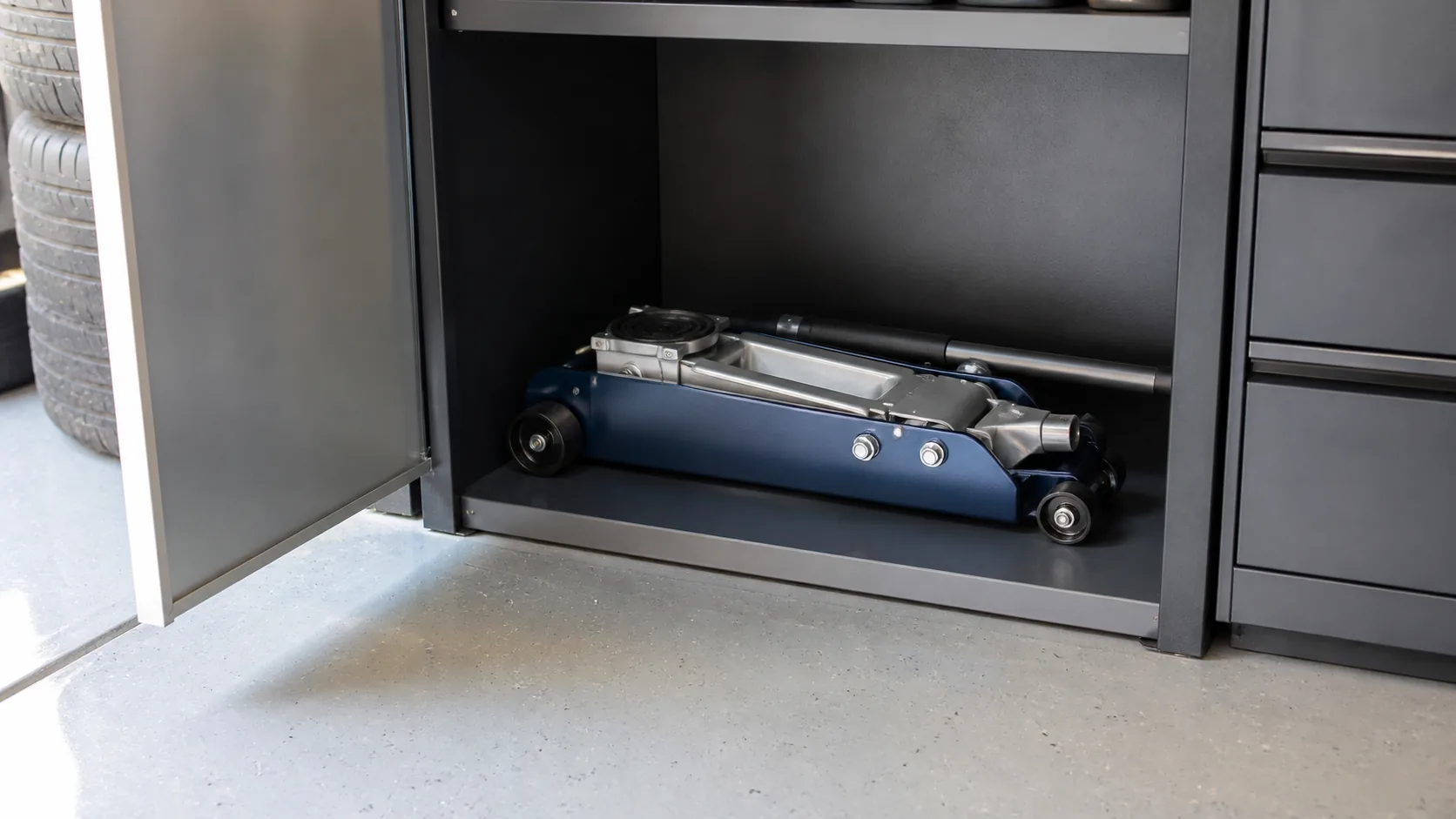
A floor jack can spend far more time parked than lifting. Moisture on the ram, grit around the seals, a raised saddle, or a handle leaning where it can fall may create the next failure long before the next repair begins.
Long-term storage is preservation, not a service interval. The aim is to remove the load, retract exposed hydraulic surfaces, prevent corrosion and contamination, and choose a location where temperature, traffic, and falling objects cannot damage the jack.
Plan the complete job before lifting. In this case, “Lower and unload the jack completely, then wipe the saddle and chassis” comes first; “After storage, inspect, bleed if required, and complete an unloaded function test before reuse” is the final control. Thinking through both ends of the sequence prevents a workable lift from turning into an awkward or unsafe lowering problem.
Quick answer: Store the jack unloaded, fully lowered, clean, dry, and in the orientation specified by its manual. Protect the saddle and ram, avoid temperature extremes, and inspect and test before returning it to service.
Prepare the jack for a quiet storage period
Storage guidance can differ for reservoir venting, handle removal, and transport orientation. Follow the model instructions, especially if the jack has been carried on its side or will sit through a humid season.
The details that matter most for long-term floor-jack storage can vary by model year, drivetrain, trim, and modification. Use the exact vehicle and equipment instructions, then confirm that ram is clean, dry, and fully retracted. A photo or forum answer for a similar vehicle is supporting context, not final authority.
Choose a dry, protected parking location
Compare the setup as a system rather than judging one specification in isolation. For long-term floor-jack storage, “No active leak, wet cleaning residue, or trapped dirt remains” and “Storage floor is dry, level, and protected from vehicle traffic” must both be true; extra capacity cannot correct poor geometry or an unsuitable contact point.
- Ram is clean, dry, and fully retracted.
- No active leak, wet cleaning residue, or trapped dirt remains.
- Storage floor is dry, level, and protected from vehicle traffic.
- Handle, adapters, and small parts are secured without loading the controls.
Put the jack away without trapping moisture
Walk through the work while the tires are still on the floor. Start with “Lower and unload the jack completely, then wipe the saddle and chassis,” confirm where the jack and stands will sit, and leave enough access to complete “After storage, inspect, bleed if required, and complete an unloaded function test before reuse” without moving loaded equipment.
- Lower and unload the jack completely, then wipe the saddle and chassis.
- Clean around wheels and seals without directing water or solvent into the hydraulic system.
- Lubricate only the pivots or points named in the owner’s manual.
- Cover loosely in a dry location where condensation can escape.
- After storage, inspect, bleed if required, and complete an unloaded function test before reuse.
What to check before the next lift
Do not store a vehicle on the jack, leave the saddle raised, park it beneath a leak, or seal a damp jack inside an airtight bag.
The safe limit for long-term floor-jack storage is reached before guesswork or improvisation begins. Keep the vehicle as low as the repair allows, use firm level concrete and correctly rated stands, and keep every part of your body outside the crush zone until the support points are loaded and checked.
Common mistakes to avoid
- Leaving the polished ram exposed for months.
- Wrapping a wet jack so condensation remains against the metal.
- Parking it where a tire, door, or dropped tool can strike the release linkage.
- Taking it straight from storage to a full vehicle lift without an unloaded check.
Safety reminder for how to store a floor jack: the jack raises the vehicle; it does not replace a support stand. Except for the limited roadside wheel-change procedure described by the vehicle maker, transfer the load to correctly rated stands before any part of your body enters the under-vehicle danger zone.
Frequently asked questions
Should a floor jack be stored with the valve open or closed?
Follow the model manual. Fully lowering the saddle is common, but release-valve and vent instructions can differ by design.
Can I store a floor jack in an outdoor shed?
Only if the space remains dry and avoids condensation, flooding, corrosive chemicals, and extreme temperatures specified against by the manufacturer.
What if the jack was stored on its side?
Return it to the approved orientation, inspect for leakage, allow the fluid to settle if instructed, then bleed and test it before use.
Related guides
- How Often Should You Service a Floor Jack?
- How To Properly Maintain Your Floor Jack
- What Hydraulic Oil Should You Use in a Floor Jack?
- Floor Jack Won’t Go Down: Safe Troubleshooting Steps
Final thoughts
Good storage keeps clean hydraulic surfaces retracted, controls protected, and moisture away. The first lift after a long pause should always begin with inspection and unloaded operation.
Source note for how to store a floor jack: this guide was checked against ASME PASE safety standard overview. Use that safety context together with the instructions, limits, and lift points published by your vehicle and equipment manufacturers.