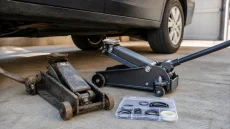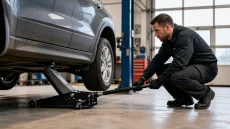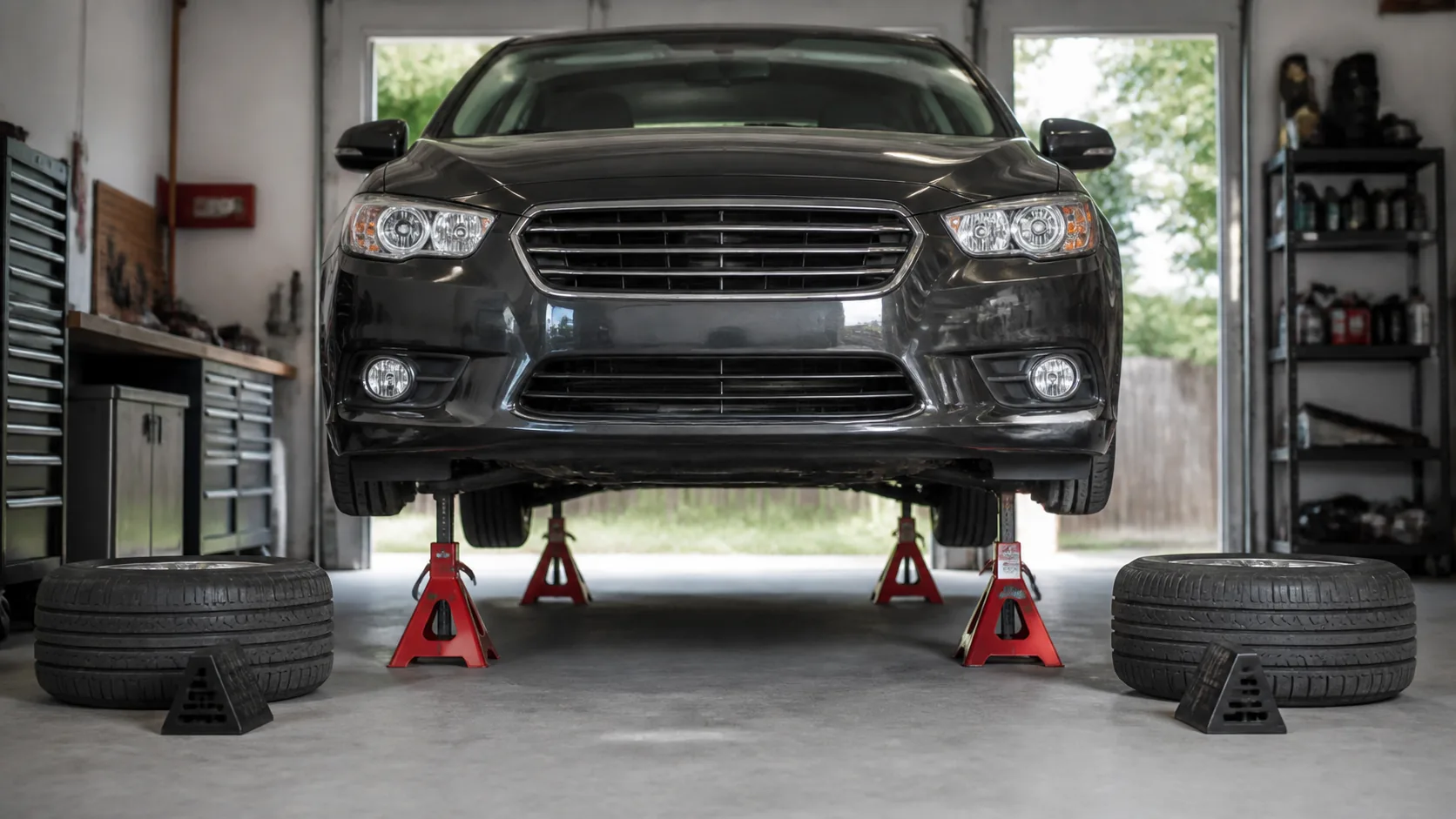
Supporting all four corners removes the grounded tires that normally resist movement. It also means using two pairs of stands—an arrangement that many stand instructions do not permit and that HSE guidance cautions against for most axle stands.
Before planning a four-stand setup, read both stand manuals and the vehicle service procedure. If either limits use to a single pair, or if the vehicle maker provides no approved full-support sequence, do not improvise; use a suitable professional vehicle lift or another manufacturer-approved system.
Plan the complete job before lifting. In this case, “Review the stand and vehicle instructions; choose a professional lift if two pairs are not allowed” comes first; “Set the second pair, inspect all eight feet and four saddles, then perform the permitted stability check from outside the crush zone” is the final control. Thinking through both ends of the sequence prevents a workable lift from turning into an awkward or unsafe lowering problem.
Quick answer: Use four stands only when the stand manufacturer and the vehicle procedure explicitly permit two matched pairs. Work on verified structural concrete, raise in controlled stages, and keep the vehicle as low and level as possible. Otherwise, use an approved professional lifting system.
First confirm that two stand pairs are permitted
Permission comes before technique. Confirm the number of stands allowed, pair-rating language, front and rear lift sequence, support-point locations, and whether opening panels or removing heavy components will change the vehicle’s balance.
The details that matter most for four-stand vehicle support can vary by model year, drivetrain, trim, and modification. Use the exact vehicle and equipment instructions, then confirm that both stand manuals permit the proposed two-pair arrangement. A photo or forum answer for a similar vehicle is supporting context, not final authority.
Match all four supports and the floor
Compare the setup as a system rather than judging one specification in isolation. For four-stand vehicle support, “All four stands are compatible in model, rating, locking design, saddle shape, and useful height” and “The vehicle procedure identifies four sound support points and an approved lifting sequence” must both be true; extra capacity cannot correct poor geometry or an unsuitable contact point.
- Both stand manuals permit the proposed two-pair arrangement.
- All four stands are compatible in model, rating, locking design, saddle shape, and useful height.
- The vehicle procedure identifies four sound support points and an approved lifting sequence.
- The concrete floor is verified level and component removal will not shift the center of gravity.
Raise in the documented sequence
Walk through the work while the tires are still on the floor. Start with “Review the stand and vehicle instructions; choose a professional lift if two pairs are not allowed,” confirm where the jack and stands will sit, and leave enough access to complete “Set the second pair, inspect all eight feet and four saddles, then perform the permitted stability check from outside the crush zone” without moving loaded equipment.
- Review the stand and vehicle instructions; choose a professional lift if two pairs are not allowed.
- Chock and raise the first end only as the approved sequence directs.
- Set and fully load the first matched pair while watching both bases and saddles.
- Raise the second end in small stages and stop if the first pair unloads or moves.
- Set the second pair, inspect all eight feet and four saddles, then perform the permitted stability check from outside the crush zone.
Stop conditions for a four-corner setup
Stop if an already loaded stand becomes light, moves, rocks, or tilts while the opposite end rises. Do not continue when manuals are silent, stands differ, the floor is questionable, or the repair will significantly redistribute weight.
The safe limit for four-stand vehicle support is reached before guesswork or improvisation begins. Keep the vehicle as low as the repair allows, use firm level concrete and correctly rated stands, and keep every part of your body outside the crush zone until the support points are loaded and checked.
Common mistakes to avoid
- Assuming any two stand pairs can be combined because their printed ton ratings match.
- Using stands whose manuals limit the setup to one pair.
- Trying to level four supports with wood, shims, or unequal locking positions.
- Removing an engine, transmission, battery pack, or axle without planning for the resulting center-of-gravity change.
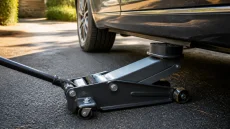
Safety reminder for four jack stands: the jack raises the vehicle; it does not replace a support stand. Except for the limited roadside wheel-change procedure described by the vehicle maker, transfer the load to correctly rated stands before any part of your body enters the under-vehicle danger zone.
Frequently asked questions
Does HSE recommend using four axle stands?
HSE states that for most axle stands no more than a single pair should be used. Follow the exact stand instructions and use a professional lift when a two-pair setup is not explicitly supported.
Can I mix two different pairs with the same rating?
Do not assume so. Differences in height increments, saddle shape, base geometry, and rating method can load the vehicle unevenly.
What is the safer alternative when four stands are not approved?
Use a correctly rated professional vehicle lift or another system specifically approved for full-vehicle support and the intended repair.
Related guides
- Where to Place Jack Stands Under a Car
- Can You Leave a Car on Jack Stands Overnight?
- Ratchet vs Pin-Style Jack Stands
- Jack Stand Weight Ratings Explained
Final thoughts
Four-corner support is not a default extension of ordinary two-stand use. The equipment and vehicle manufacturers must support the arrangement; otherwise, the safe choice is a purpose-built professional lift.
Source note for four jack stands: this guide was checked against UK HSE vehicle-lifting safety guidance. Use that safety context together with the instructions, limits, and lift points published by your vehicle and equipment manufacturers.