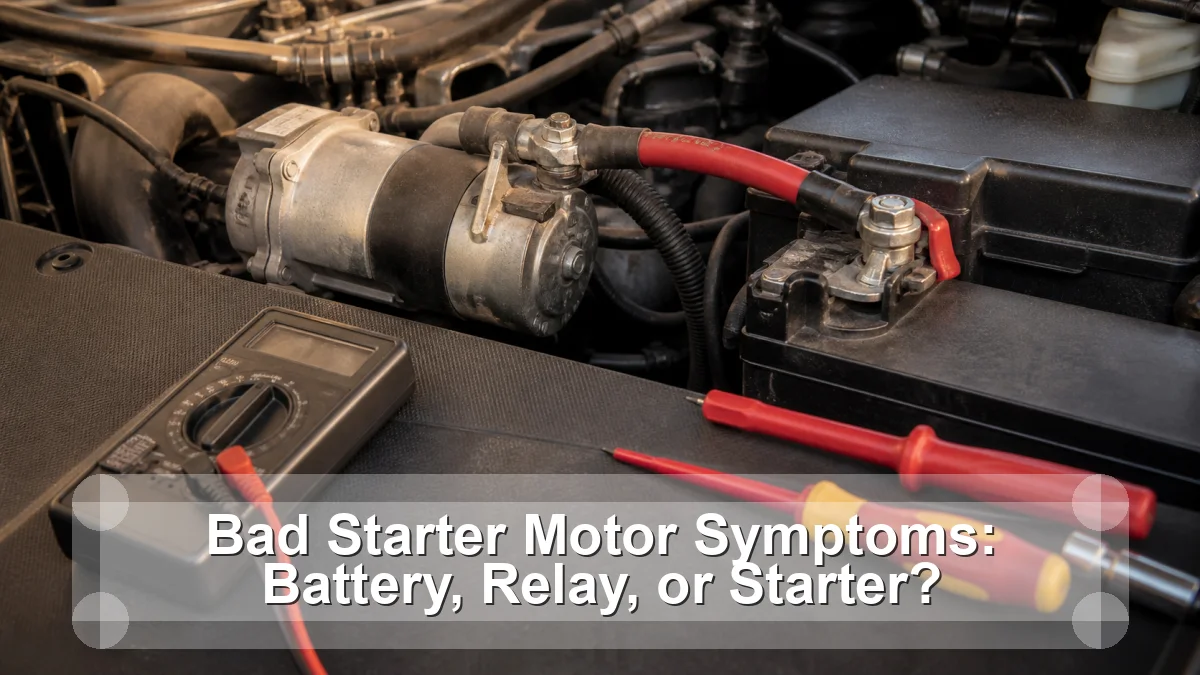
A bad starter motor can cause a single heavy click, intermittent no-crank, slow cranking despite a proven battery and low-resistance cables, grinding, or a starter that spins without turning the engine. Those clues overlap with a weak battery, loose ground, relay, ignition switch, neutral-safety switch, seized engine, and damaged ring gear, so test the circuit before buying a starter.
This guide is a diagnosis and decision aid for a home-garage owner, not a claim that one symptom proves one failed part. Vehicle design, service limits, warning behavior, and test conditions vary, so the exact owner manual and service information remain the final authority.
Use timing and condition as evidence
The fastest useful move is to describe what changed, when it happens, and what does not happen. The table below is a triage card: it narrows the next check but deliberately avoids turning a clue into a verdict.
| What you notice | What it suggests | Best next move |
|---|---|---|
| Rapid repeated clicks | Low voltage or poor connection is common | Starter itself is not yet proven |
| One solid click with good battery | Solenoid, motor, cable, or mechanical bind | Circuit testing is required |
| Silence and normal dash lights | Control side or interlock may be open | Check relay command and switches |
| Grinding during crank | Drive gear or ring gear issue | Stop to prevent more damage |
| Starter whirs but engine does not turn | Drive engagement failure | Do not keep trying |
Use several matching clues. One reading, one noise, or one dashboard lamp can be affected by temperature, recent service, battery state, road conditions, or the way the vehicle’s control system is designed.
The no-parts-darts diagnostic path
- Name the complaint precisely. If the engine rotates normally but does not fire, the starter has done its main job. This article owns no-crank, weak-crank, grind, and non-engagement patterns.
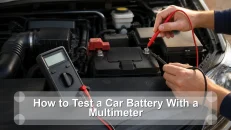
- Prove the power source. Test battery state and capacity, clean and tighten terminals as specified, and inspect engine-to-body grounds. Headlights working does not prove the battery can supply starter current.
- Check interlocks. Try Park and Neutral as the owner manual allows, fully depress the clutch where applicable, and observe security or key warnings. Do not bypass safety switches.
- Measure the circuit. A technician can compare voltage at the starter command terminal and perform positive- and ground-side voltage-drop tests during a brief crank request.
- Inspect mechanical evidence. Grinding, damaged teeth, a seized accessory, fluid-locked cylinder, or a mechanically locked engine changes the repair. Do not keep energizing the starter into a bind.
Write the observations down. A short record of conditions, readings, warning lamps, and recent work is more valuable to a technician than a replacement-part theory. If a test requires bypassing a safety system, opening a pressurized circuit, working near moving parts, or lifting beyond your equipment, stop at the observation stage.
No-crank sound and voltage comparison matrix
The table and ordered checks above form the article’s working value object. To use it, circle the row that most closely matches the complaint, complete the next check, then revise the hypothesis. A result that contradicts the first guess is progress: it prevents a good component from being replaced and keeps the real fault visible.
Add three lines to the worksheet: conditions (cold, hot, wet, speed, load), evidence (measurement, code, wear, leak, sound), and decision (safe to monitor, book inspection, or stop and tow). That simple structure makes the diagnosis repeatable without pretending every vehicle shares one specification.
Common wrong turns
The tempting shortcut
Buying a starter after hearing clicks skips the battery and cable checks that cause many identical complaints. A safe repair plan should explain both the failed condition and the evidence that ruled out its closest look-alikes.
The misleading assumption
Striking a starter may create a temporary response but is not a safe diagnosis or repair plan. A safe repair plan should explain both the failed condition and the evidence that ruled out its closest look-alikes.
The incomplete repair
Bypassing a relay or interlock can make the vehicle move unexpectedly and damage the control circuit. A safe repair plan should explain both the failed condition and the evidence that ruled out its closest look-alikes.
When to stop
Stop for grinding, smoke, a hot cable, a strong electrical odor, repeated heavy clunks, or a starter that remains engaged after the key is released. Move the ignition off and disconnect power only according to service information. A vehicle that can move unexpectedly must be secured before any circuit test.
When the decision is “stop,” do not let schedule or convenience turn it back into “drive carefully.” Secure the vehicle away from traffic, use hazard warnings where appropriate, and arrange roadside or workshop help. Safety-critical faults can change faster than a symptom list suggests.
Related guides
- How to Test a Car Battery With a Multimeter
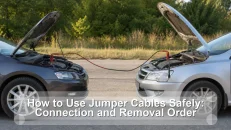
- How to Use Jumper Cables Safely: Connection and Removal Order
- How to Check an Alternator: A Battery-to-Charging-System Test
These links are selected for the next safe decision rather than for keyword repetition. They cover the closest supporting check, tool, or workshop-safety step available before this article’s publication date.
Frequently asked questions
Can a bad starter drain the battery?
Repeated failed crank attempts certainly can. An internal short or a starter that remains engaged can also draw excessive current, but a separate key-off drain is possible.
Why does the car start in Neutral but not Park?
That pattern points toward shifter adjustment or the transmission range/neutral-safety circuit rather than proving the starter motor failed.
Can a starter fail only when hot?
Yes. Heat can change internal resistance, worn contacts, bushings, or clearances. A hot-only pattern still needs voltage-drop and control-circuit testing.
Sources
- HELLA Tech World: starting-system diagnosis and starter checks
- Fluke: measuring automotive battery voltage with a multimeter
Bottom line: A bad starter motor can cause a single heavy click, intermittent no-crank, slow cranking despite a proven battery and low-resistance cables, grinding, or a starter that spins without turning the engine. Those clues overlap with a weak battery, loose ground, relay, ignition switch, neutral-safety switch, seized engine, and damaged ring gear, so test the circuit before buying a starter. Use the evidence path, respect the stop conditions, and confirm the exact repair against vehicle-specific information.