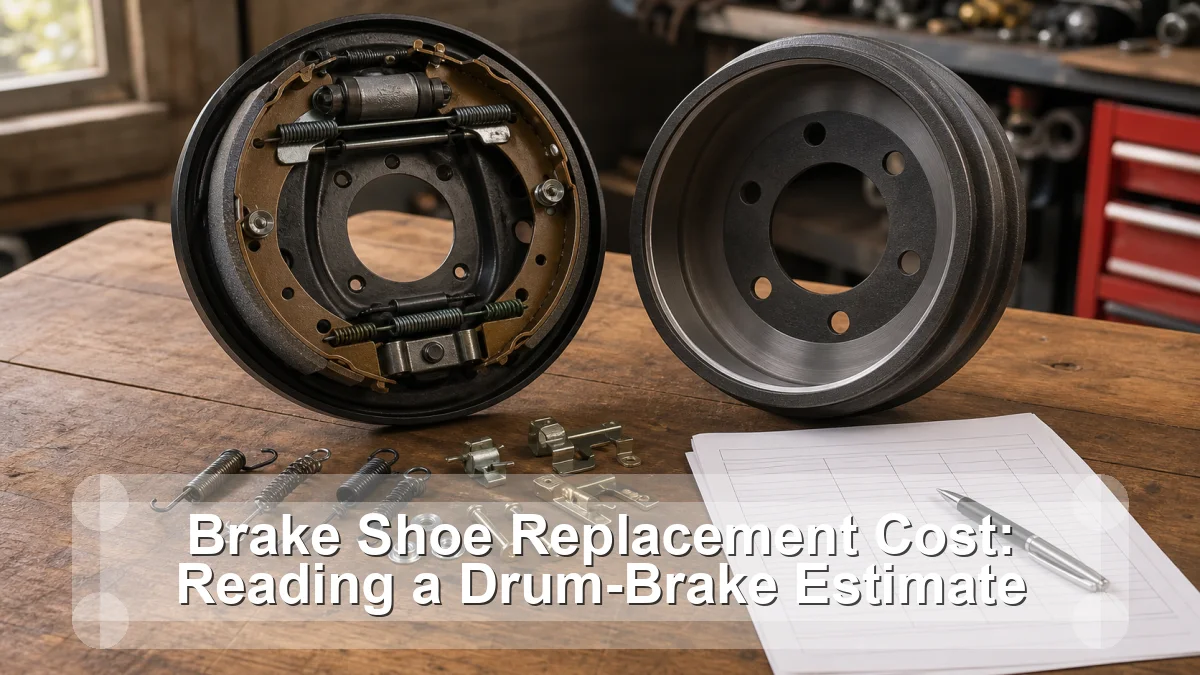
A current U.S. national estimator places a typical brake-shoe replacement around $318–$402 before taxes, location, and related repairs, but drum-brake quotes vary widely. Confirm whether the number covers both wheels on one axle, hardware, drum measurement or replacement, wheel-cylinder inspection, adjustment, and fluid or bleeding work.
This guide is a diagnosis and decision aid for a home-garage owner, not a claim that one symptom proves one failed part. Vehicle design, service limits, warning behavior, and test conditions vary, so the exact owner manual and service information remain the final authority.
Use timing and condition as evidence
The fastest useful move is to describe what changed, when it happens, and what does not happen. The table below is a triage card: it narrows the next check but deliberately avoids turning a clue into a verdict.
| What you notice | What it suggests | Best next move |
|---|---|---|
| Shoes worn evenly, drums within spec | Basic axle service may fit | Hardware still inspected |
| One shoe wet with fluid | Wheel-cylinder or axle-seal leak | Leak repair expands scope |
| Drum grooved or over maximum diameter | Machine or replace by specification | Do not fit shoes blindly |
| Hardware rusty or heat-damaged | Spring and adjuster service | Quote should include it |
| One wheel drags | Adjustment, cable, cylinder, or hardware fault | Find cause first |
Use several matching clues. One reading, one noise, or one dashboard lamp can be affected by temperature, recent service, battery state, road conditions, or the way the vehicle’s control system is designed.
The no-parts-darts diagnostic path
- Confirm drum brakes. Some vehicles use rear discs with small parking-brake shoes; the labor and parts are different from full rear drum brakes.
- Ask for measured findings. Shoe thickness, contamination, drum inside diameter, surface condition, wheel-cylinder leakage, adjuster movement, and hardware condition support the recommendation.
- Normalize the quote. Compare one axle, both wheels, exact parts, labor hours, machining, disposal, fluid, taxes, and shop supplies.
- Choose complete parts scope. Shoes are replaced as an axle set. Hardware, drums, cylinders, seals, and cables are added only when condition or manufacturer procedure supports them.
- Verify the finish. Adjustment, free rotation, parking-brake operation, leak check, pedal feel, torque, and controlled road verification belong in a complete job.
Write the observations down. A short record of conditions, readings, warning lamps, and recent work is more valuable to a technician than a replacement-part theory. If a test requires bypassing a safety system, opening a pressurized circuit, working near moving parts, or lifting beyond your equipment, stop at the observation stage.
Per-axle drum-brake quote checklist
The table and ordered checks above form the article’s working value object. To use it, circle the row that most closely matches the complaint, complete the next check, then revise the hypothesis. A result that contradicts the first guess is progress: it prevents a good component from being replaced and keeps the real fault visible.
Add three lines to the worksheet: conditions (cold, hot, wet, speed, load), evidence (measurement, code, wear, leak, sound), and decision (safe to monitor, book inspection, or stop and tow). That simple structure makes the diagnosis repeatable without pretending every vehicle shares one specification.
Common wrong turns
The tempting shortcut
Quoting one wheel makes an axle repair look artificially cheap. A safe repair plan should explain both the failed condition and the evidence that ruled out its closest look-alikes.
The misleading assumption
Installing shoes contaminated by brake fluid or gear oil is not a durable repair. A safe repair plan should explain both the failed condition and the evidence that ruled out its closest look-alikes.
The incomplete repair
Reusing weak or distorted hardware can create noise, drag, or uneven application. A safe repair plan should explain both the failed condition and the evidence that ruled out its closest look-alikes.
When to stop
Do not drive for fluid-contaminated brakes, grinding, a sinking pedal, severe pull, smoke, or a dragging hot rear wheel. Drum springs store energy and layouts vary; DIY work needs the exact manual, correct tools, eye protection, and safe vehicle support.
When the decision is “stop,” do not let schedule or convenience turn it back into “drive carefully.” Secure the vehicle away from traffic, use hazard warnings where appropriate, and arrange roadside or workshop help. Safety-critical faults can change faster than a symptom list suggests.
Related guides
- Parking Brake Cable Replacement Cost: What Changes the Quote
- Brake Fluid Leak? Find the Source and Stop Driving Safely
- Floor Jack Safety Checklist
These links are selected for the next safe decision rather than for keyword repetition. They cover the closest supporting check, tool, or workshop-safety step available before this article’s publication date.
Frequently asked questions
What is the average brake-shoe replacement cost?
RepairPal listed about $318–$402 in July 2026, excluding taxes, location, and related work. Your VIN-specific quote may differ substantially.
Do drums always need replacement with shoes?
No. They must be measured and inspected. Machining or replacement depends on diameter limits, damage, heat, surface, and local service capability.
Should wheel cylinders be replaced automatically?
Not automatically, but leakage, sticking, corrosion, age, and access may support replacement. Both sides should be inspected.
Sources
- RepairPal: current brake-shoe replacement estimate and service scope
- California Bureau of Automotive Repair: brake inspection and diagnosis handbook
Bottom line: A current U.S. national estimator places a typical brake-shoe replacement around $318–$402 before taxes, location, and related repairs, but drum-brake quotes vary widely. Confirm whether the number covers both wheels on one axle, hardware, drum measurement or replacement, wheel-cylinder inspection, adjustment, and fluid or bleeding work. Use the evidence path, respect the stop conditions, and confirm the exact repair against vehicle-specific information.