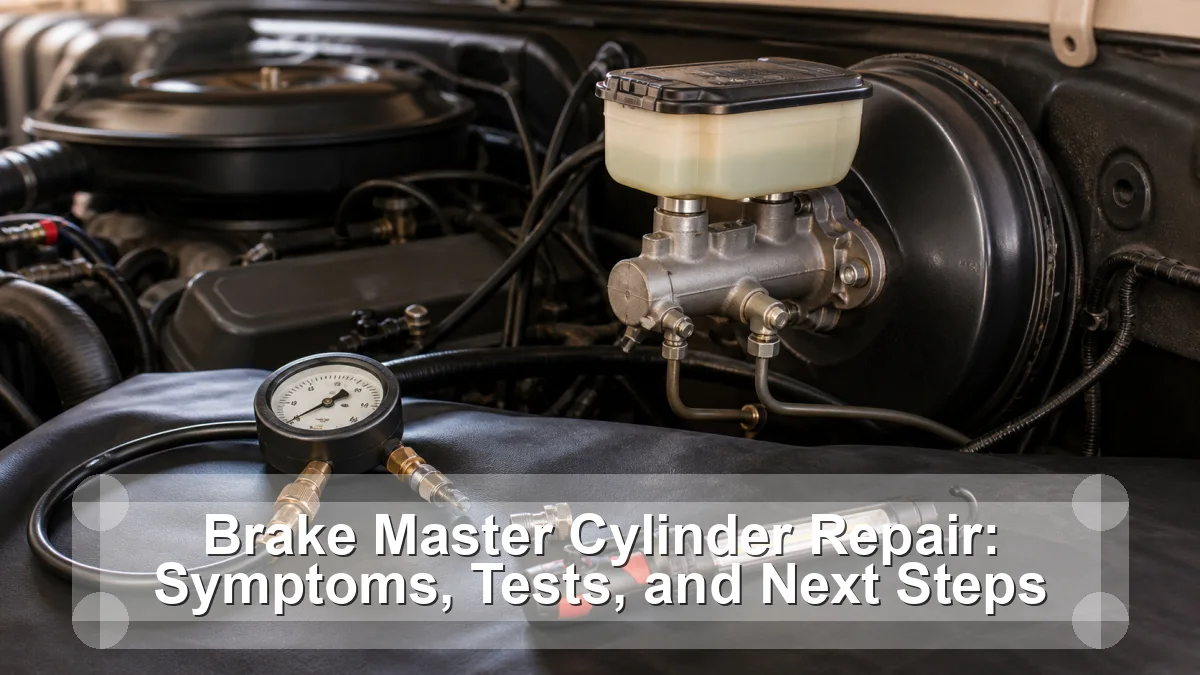
Suspect the master cylinder when a correctly bled system has a pedal that slowly sinks under steady pressure, fluid leaks at the cylinder or into the booster, or hydraulic circuits fail to build pressure. Air, external leaks, flexible hoses, calipers, wheel cylinders, ABS hydraulics, adjustment, and booster behavior can feel similar.
This guide is a diagnosis and decision aid for a home-garage owner, not a claim that one symptom proves one failed part. Vehicle design, service limits, warning behavior, and test conditions vary, so the exact owner manual and service information remain the final authority.
Read the pattern before choosing a part
The fastest useful move is to describe what changed, when it happens, and what does not happen. The table below is a triage card: it narrows the next check but deliberately avoids turning a clue into a verdict.
| What you notice | What it suggests | Best next move |
|---|---|---|
| Pedal slowly sinks while held | Internal bypass or external leak | Stop and diagnose hydraulics |
| Pedal pumps higher | Air, adjustment, knock-back, or leak | Master cylinder not proven |
| Pedal hard with engine running | Booster or vacuum assist issue | Hydraulic pressure may still be present |
| Fluid at rear of master cylinder | External seal leak possible | Inspect booster contamination |
| One circuit weak | Dual-circuit hydraulic fault | Professional pressure testing |
Use several matching clues. One reading, one noise, or one dashboard lamp can be affected by temperature, recent service, battery state, road conditions, or the way the vehicle’s control system is designed.
A practical check sequence
- Make it stationary. Park, chock wheels, and do not drive if the pedal sinks, fluid is low, a red warning is on, or stopping changed.
- Inspect outside first. Check reservoir, master-cylinder body, line fittings, booster area, ABS unit, lines, hoses, calipers, and drum interiors for leakage.
- Characterize pedal behavior. With service information, note engine-off reserve, engine-running assist, steady-pressure sink, pump-up, and timing. Avoid repeated pumping that empties a leak.
- Isolate by specification. Technicians use hydraulic plugs or pressure gauges only with approved procedures; indiscriminate line clamping can damage hoses and mislead diagnosis.
- Complete the repair. Use the correct cylinder, bench-bleed method, fluid, line torque, vehicle sequence, scan-tool ABS bleed if required, leak checks, and brake-performance verification.
Write the observations down. A short record of conditions, readings, warning lamps, and recent work is more valuable to a technician than a replacement-part theory. If a test requires bypassing a safety system, opening a pressurized circuit, working near moving parts, or lifting beyond your equipment, stop at the observation stage.
Internal-bypass versus external-leak decision matrix
The table and ordered checks above form the article’s working value object. To use it, circle the row that most closely matches the complaint, complete the next check, then revise the hypothesis. A result that contradicts the first guess is progress: it prevents a good component from being replaced and keeps the real fault visible.
Add three lines to the worksheet: conditions (cold, hot, wet, speed, load), evidence (measurement, code, wear, leak, sound), and decision (safe to monitor, book inspection, or stop and tow). That simple structure makes the diagnosis repeatable without pretending every vehicle shares one specification.
Common wrong turns
The tempting shortcut
A hard pedal usually points toward assist, not automatically the master cylinder. A safe repair plan should explain both the failed condition and the evidence that ruled out its closest look-alikes.
The misleading assumption
Replacing the cylinder without fixing an external leak or rear-brake adjustment leaves the pedal problem. A safe repair plan should explain both the failed condition and the evidence that ruled out its closest look-alikes.
The incomplete repair
Clamping flexible hoses with locking pliers can damage them internally. A safe repair plan should explain both the failed condition and the evidence that ruled out its closest look-alikes.
When to stop
Tow the vehicle for a sinking pedal, fluid loss, red warning, reduced braking, or a pedal near the floor. Brake hydraulics are safety-critical; stop if correct plugs, bleeding equipment, scan procedure, torque data, or safe support are unavailable.
When the decision is “stop,” do not let schedule or convenience turn it back into “drive carefully.” Secure the vehicle away from traffic, use hazard warnings where appropriate, and arrange roadside or workshop help. Safety-critical faults can change faster than a symptom list suggests.
Related guides
- Brake Fluid Leak? Find the Source and Stop Driving Safely
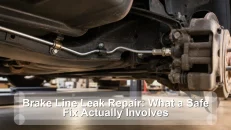
- Brake Line Leak Repair: What a Safe Fix Actually Involves
- What Does the ABS Brake Light Mean?
These links are selected for the next safe decision rather than for keyword repetition. They cover the closest supporting check, tool, or workshop-safety step available before this article’s publication date.
Frequently asked questions
Can a master cylinder fail without leaking outside?
Yes. Internal seals can bypass fluid between chambers, allowing the pedal to sink without an obvious exterior puddle.
Can air in the brakes mimic master-cylinder failure?
Yes. Air, poor rear adjustment, hose expansion, pad knock-back, external leaks, and ABS hydraulic faults can all change pedal travel.
Should a master cylinder be rebuilt or replaced?
Vehicle design, bore condition, approved kits, contamination, parts support, and local practice decide. Many modern units are replaced as assemblies.
Sources
- California Bureau of Automotive Repair: brake inspection and diagnosis handbook
- California BAR: master-cylinder cup failure and hydraulic diagnosis guidance
Bottom line: Suspect the master cylinder when a correctly bled system has a pedal that slowly sinks under steady pressure, fluid leaks at the cylinder or into the booster, or hydraulic circuits fail to build pressure. Air, external leaks, flexible hoses, calipers, wheel cylinders, ABS hydraulics, adjustment, and booster behavior can feel similar. Use the evidence path, respect the stop conditions, and confirm the exact repair against vehicle-specific information.