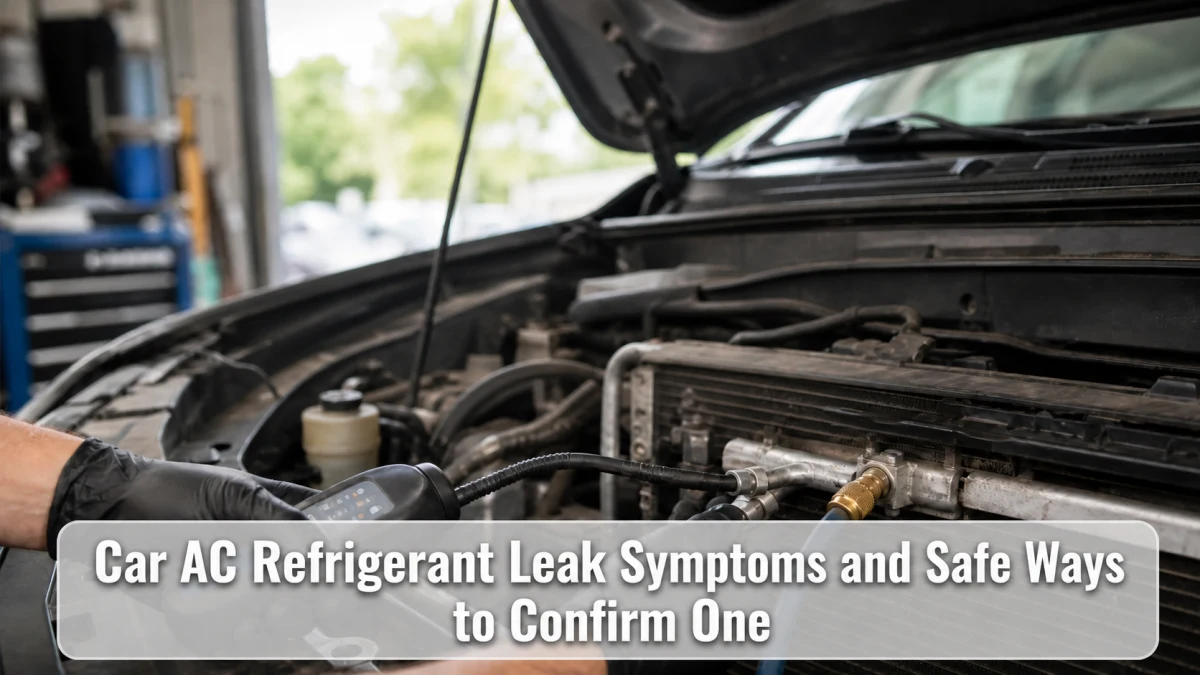
A refrigerant leak becomes likely when AC cooling fades over weeks or months, oily residue appears around a hose or fitting, or the system cools again only briefly after a recharge. A hiss by itself does not confirm a leak, and refrigerant has no reliable color or odor that a driver should use for diagnosis.
Why low refrigerant usually points to a leak
An intact AC circuit recirculates refrigerant; it does not burn it as the engine burns fuel. Small amounts can escape through aged seals or damaged components, and service work can also leave a system undercharged. EPA explains that topping off may restore performance but does not permanently repair a leak.
Cooling performance alone cannot show how much refrigerant remains. Charge is specified by mass, while operating pressures change with ambient temperature, airflow, compressor command, humidity, and system design.
Leak-sign confidence ladder
| Observation | How much it tells you | Important limitation |
|---|---|---|
| Air is not cold | Shows an AC problem exists | Airflow, door, sensor, fan, or compressor faults can do the same |
| Cooling faded gradually | Raises suspicion of a slow leak | Progressive compressor or control faults remain possible |
| Cooling returned briefly after recharge | Strongly suggests charge was low | Does not locate the leak |
| Oily dirt at one fitting | Provides a useful inspection target | Old service oil or another fluid can mislead |
| Electronic detector responds repeatedly | Can localize escaping refrigerant | Tool suitability and technique matter |
| Approved dye appears at a component | Can confirm a leak path | Only the correct dye and amount should be used |
Common places refrigerant escapes
Leak points include service-port valves, hose crimps, O-rings, compressor shaft seals, the condenser, receiver-drier or accumulator connections, and the evaporator. Road debris makes the condenser vulnerable. Evaporator leaks are harder to see because the component sits inside the HVAC case.
Water dripping under the passenger area after AC use is normally condensation, not refrigerant. Refrigerant leaving the system becomes a gas under ordinary conditions, while compressor oil or tracer dye may remain as visible evidence.
What a hissing sound means
A brief hiss after shutdown can be pressure equalizing through the expansion device and may be normal. A continuous hiss paired with poor cooling deserves diagnosis, but sound can also come from an air door, vacuum line, or airflow restriction. Record when the sound starts, where it seems loudest, and whether vent temperature changes.
How a shop confirms the leak
- Identify the refrigerant. The under-hood label and service fittings provide the starting point; contaminated or mixed refrigerant requires special handling.
- Inspect visible components. The technician looks for impact damage, oily residue, loose caps, and previous repair evidence.
- Recover and measure what remains when service requires opening the circuit. Approved equipment prevents deliberate release and allows charge comparison.
- Use an appropriate detection method. Electronic detection, manufacturer-approved fluorescent dye, nitrogen or forming-gas testing, and vacuum-decay checks each have limits.
- Repair and verify. The failed seal or component is replaced, the system is evacuated, charged by the specified mass, and checked for performance and leaks.
Why stop-leak is a poor default
Sealant does not distinguish a leak from small passages or service equipment. It can complicate future recovery and repair, and it does not correct impact damage, a failed compressor seal, or a corroded evaporator. Use a product only when the vehicle and equipment manufacturers explicitly permit it.
Refrigerant safety and legal boundary
Do not intentionally release refrigerant. Avoid unapproved hydrocarbon replacements; EPA warns that some hydrocarbon refrigerants marketed for vehicle AC are not approved and can introduce fire risk. A shop servicing motor-vehicle AC for compensation must use certified equipment and Section 609-certified technicians.
High-voltage compressors in hybrids and EVs add electrical and oil-compatibility risks. They are not ordinary 12-volt DIY work.
For a preliminary airflow diagnosis, start with the guide to a car AC that is not blowing cold. If inspection requires safe access below the front of the vehicle, follow the floor-jack safety checklist.
Frequently asked questions
Can refrigerant leak without visible oil?
Yes. A small leak may leave little accessible residue, especially at an evaporator. A clean component does not rule it out.
How long should a recharge last?
There is no honest universal answer. An intact repair should retain its specified charge, while an unrepaired leak may lose cooling quickly or gradually depending on its size and operating conditions.
Can I find a leak with soapy water?
Soap solution can reveal bubbles at some accessible pressurized joints, but it cannot reach every component and should not be introduced into service ports. Use manufacturer-approved procedures.
Sources
- US EPA: leak repair and recharge options
- US EPA: servicing information for technicians
- US EPA: hydrocarbon refrigerant safety
- AutoZone: AC leak-detection overview
Bottom line: fading cooling plus repeat charge loss or localized oily residue makes a leak plausible. Confirm the location with proper equipment, repair the fault, and charge the exact specified mass.