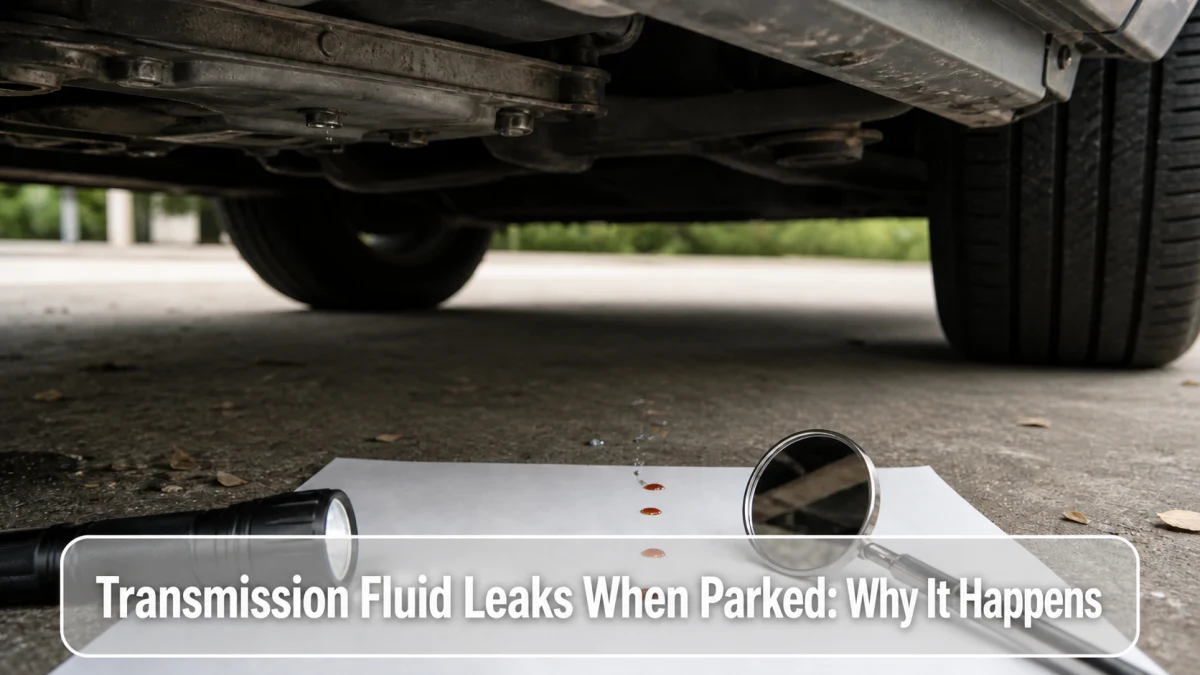
A transmission leak can become visible only after parking because hot fluid thins, internal oil drains back, the case heat-soaks, or fluid collected on a shield finally drips. The puddle’s position is not the source. Confirm the fluid, clean the area, and trace fresh wetness to its highest point.
Why the puddle appears after shutdown
When the engine stops, fluid circulating through the transmission and cooler circuit can return to the case. Components remain hot and expand or contract at different rates. Thin warm fluid may pass a marginal seal or gasket, then accumulate on a pan edge, mount, crossmember, or splash shield before reaching the floor.
Parking angle matters too. A leak that remains above the fluid level on flat ground may become submerged on a slope, while fluid on a shield can run toward a different drip point.
Parked-versus-running leak source table
| When fresh wetness appears | Possible areas | Useful next observation |
|---|---|---|
| Only after a hot drive | Vent, case seam, pan, cooler return, seals | Inspect immediately after shutdown and again when cold |
| Only while engine runs | Pressurized cooler line, pump-area seal, active circuit | Observe safely with guards installed |
| After several hours | Drain-back raises case level; shield releases collected fluid | Trace above the final drip point |
| After parking on a slope | Fill tube, vent, axle seal, case joint | Repeat on level ground only if safe |
| Immediately after service | Spill, plug seal, pan seal, overfill, fill point | Review quantity and clean service residue |
| Near a front corner | Cooler hose or radiator heat-exchanger connection | Follow lines both directions |
Confirm that it is transmission fluid
ATF and CVT fluids come in several colors and can darken with age. Engine oil, hydraulic steering fluid, coolant, and gear oil overlap in appearance and travel along the underbody. Use the fluid color and texture comparison card, but treat color as only one clue.
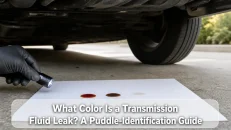
Place white cardboard under the parked vehicle and mark tire positions. Note the first drops, total time, weather, and whether the AC was used. Clear water is often normal condensate, while oily or dyed fluid requires more checking.
Common source areas
Pan, drain plug, and fill plug
A damaged sealing washer, distorted pan, incorrect gasket method, corrosion, or fastener problem can wet the lower case. Fluid from higher up often coats the same pan seam, so clean above it before condemning the gasket.
Axle, output, and selector seals
Seal lips can wear, but shaft movement, a damaged sealing surface, vent restriction, or installation error may be the underlying cause. Replacing a seal without checking those conditions can lead to a repeat leak.
Cooler lines and connections
Crimp joints, hoses, pipes, clips, and heat-exchanger fittings can corrode or chafe. A running leak may spray backward and appear far from the failure. Do not put hands near fans, belts, hot exhaust, or rotating driveline parts.
Case connector, cover, vent, or pump area
Electrical pass-through seals and case covers may seep. Venting can follow overfill, overheating, internal aeration, or a blocked vent. Fluid from the bellhousing area needs careful differentiation from engine oil and may require transmission removal to repair.
Trace the highest fresh wet point
- Inspect the transmission and components above it while cool.
- Photograph the existing pattern, then clean compatible surfaces.
- Dry the area and add a visual reference mark near suspected joints.
- Run or drive only if fluid level and transmission operation are safe.
- Recheck at short intervals to catch the first trace before it spreads.
- Use approved fluorescent dye only if service information permits it.
Never work beneath a vehicle held only by a hydraulic jack. Follow the floor-jack safety checklist and use rated stands at approved points on firm level ground.
Check level without creating a second problem
Some transmissions use a dipstick; others use an overflow plug and require a scan-tool temperature. Engine state, selector position, vehicle attitude, and fluid temperature can change the result. Use the correct specification and procedure. If the system was recently filled, our overfill guide explains why a bad level check can mimic a leak problem.
Frequently asked questions
Can a transmission leak only when cold?
Yes. Seal contraction, parking angle, and drain-back can expose a leak path after cooling. Compare hot and cold inspections rather than assuming one condition.
Will tightening pan bolts stop the leak?
Not necessarily. Overtightening can distort the pan or damage threads. Confirm the source and use the specified sequence and torque.
Can I drive with a few drops?
A few drops can become a larger loss, and level may already be low. Confirm the correct level and arrange repair; tow the vehicle if operation changes or the loss is rapid.
Sources
- Honda owner’s manual: transmission fluid check example
- Engineer Fix: parked transmission leak behavior
Bottom line: shutdown timing and the final drip location can hide the source. Document the pattern, clean the system, and trace the first fresh wet point before choosing a gasket or seal.