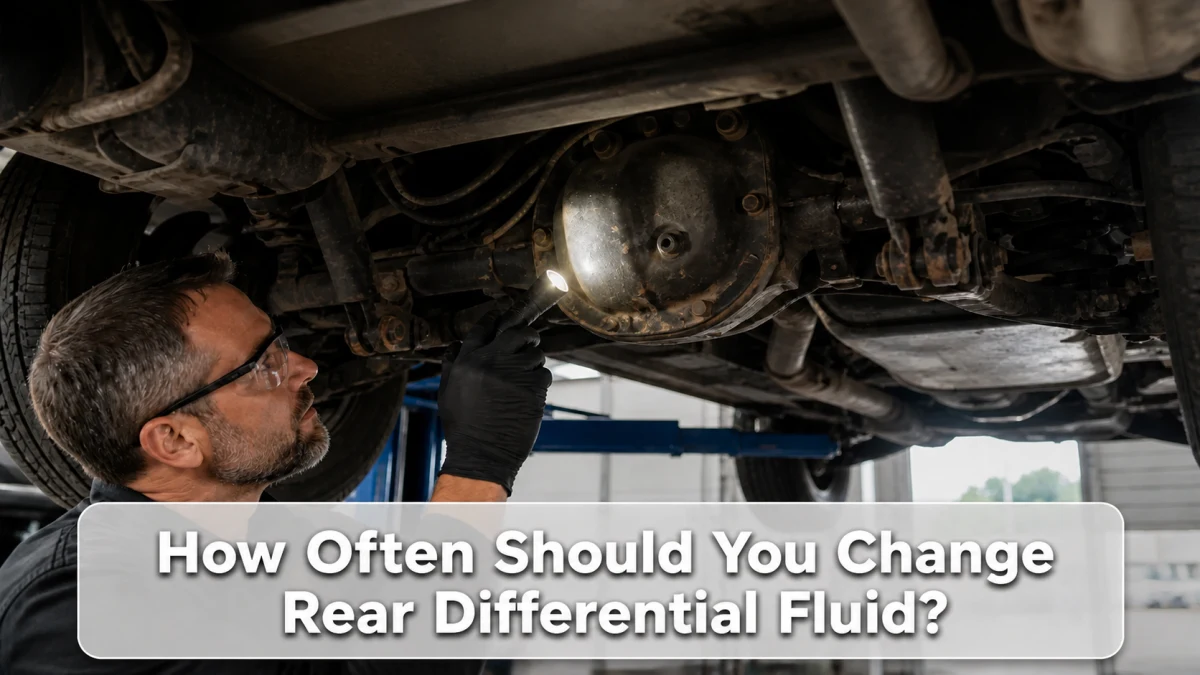
Rear differential fluid intervals vary widely by axle, lubricant, towing use, driving pattern, and water exposure. The correct answer is the normal or severe-service schedule for the exact vehicle. Towing, repeated short trips, mountain work, off-road use, or submersion can move service earlier.
Why one mileage cannot fit every differential
The differential turns and divides torque while gears and bearings operate under sliding and rolling loads. Oil carries heat, protects tooth surfaces, and suspends wear material. Axle size, oil capacity, temperature, gear design, clutch packs, and duty cycle determine how hard that oil works.
A light vehicle driven steadily on pavement is not equivalent to a truck towing near its limits, an SUV crossing water, or a performance car doing repeated track sessions. Manufacturer schedules account for at least some of these differences.
Use-case interval matrix
| How the vehicle is used | Stress on the oil | Planning rule |
|---|---|---|
| Normal mixed road driving | Baseline heat and load | Follow normal maintenance schedule |
| Frequent towing or heavy payload | Higher tooth load and temperature | Use towing/severe schedule when specified |
| Repeated steep climbs or low-speed work | High load with less cooling airflow | Inspect and service under severe guidance |
| Off-road dust and impacts | Seal, vent, and housing exposure | Inspect after events and use severe schedule |
| Water crossing or suspected submersion | Possible water entry through vent or seals | Inspect promptly; do not wait for routine mileage |
| Track or competition use | Repeated high temperature | Follow performance-use service guidance |
Manual-first research
Look in the maintenance minder, severe-conditions table, towing section, and axle-fluid specification. Some manuals provide a special early service when towing, then a repeating interval. Others inspect first or include the axle under a maintenance code. The schedule for a front differential, transfer unit, or electronically controlled coupling may be different from the rear axle.
Record the axle option or identification code. Two vehicles with the same model badge can use different axles and capacities.
Condition clues that justify attention
Wetness at a pinion seal, axle seal, cover, drain plug, fill plug, or vent indicates a leak path. A burnt odor, milky oil, metal flakes, or an abnormal sample deserves diagnosis. Fine paste on a magnetic plug can be normal wear, while larger chips, glitter, or chunks call for closer inspection.
Whine, howl, clunk, chatter, or vibration does not prove that fluid change alone will fix the axle. Level, lubricant type, bearings, gear contact, backlash, driveshafts, mounts, tires, and limited-slip operation may be involved.
Inspect the axle vent
A blocked, displaced, or submerged vent can contribute to seal leakage or water entry as pressure changes. Confirm that its hose and cap are routed and secured as the manufacturer intended. Do not replace a leaking seal without checking the vent and bearing movement, because pressure or shaft play can damage the new seal again.
Towing changes the calculation
Towing increases torque and heat, especially during grades, high ambient temperatures, and repeated low-speed maneuvers. Use the manufacturer’s towing maintenance table and remain within rated limits. An aftermarket larger cover does not automatically change the service interval or make an unapproved oil suitable.
Water exposure is event-based
A submerged or damaged vent can admit water as the axle cools. Water reduces lubrication and promotes corrosion. Milky oil is a strong clue, but waiting for visible milkiness can miss smaller contamination. After water exposure, follow the vehicle’s inspection and replacement guidance promptly.
Service method matters
- Confirm the lubricant specification, quantity, limited-slip additive requirements, and fill-level procedure.
- Verify that the fill plug can be removed before draining.
- Keep the vehicle level under the specified condition.
- Drain through the plug or remove the cover as the service procedure directs.
- Inspect the old oil, magnet, threads, sealing surface, vent, and leaks.
- Use new approved seals or gasket method and torque values from service data.
- Fill to the specified level and temperature condition, then recheck for leaks.
Never rely on “until it spills” unless the manufacturer explicitly defines that procedure and vehicle attitude. Overfill can aerate oil or push it through the vent; underfill can starve bearings.
If the vehicle must be raised, locate the correct jacking points and apply the safe lifting checklist. A jack alone is not support.
Frequently asked questions
Does synthetic differential oil last forever?
No. A synthetic lubricant may handle temperature and oxidation well, but contamination, additive depletion, leaks, and severe use still matter. Follow the approved specification and schedule.
Do I always need limited-slip additive?
No. Some axles require a separate modifier, some fluids include it, and some differential designs prohibit generic additives. Use the axle-specific service information.
Can changing fluid stop differential noise?
Correcting a wrong level or lubricant may change behavior, but established bearing or gear damage needs mechanical diagnosis. Do not use unusually thick oil to conceal a fault.
Sources
- Honda owner’s manual: maintenance schedule example
- Firestone Complete Auto Care: differential fluid overview
Bottom line: use the exact schedule for the axle and move earlier when the manufacturer classifies your driving as severe. Towing and water exposure matter more than a generic internet mileage.