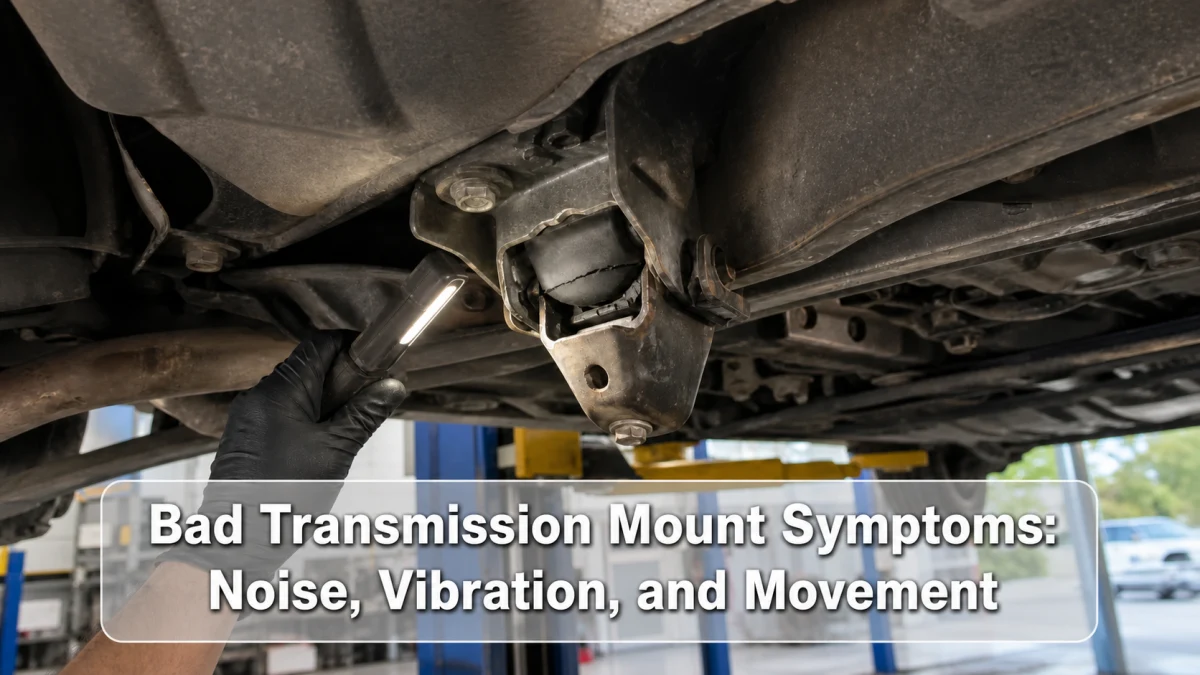
A bad transmission mount can cause a clunk when selecting drive or reverse, vibration at idle, or excessive powertrain movement under changing load. Those symptoms overlap with engine mounts, exhaust contact, CV joints, driveline lash, misfire, and internal transmission faults. Inspect all mounts and reproduce the exact load condition safely.
What a transmission mount does
Mounts locate the engine and transmission while isolating vibration and controlling torque reaction. Depending on the vehicle, they can use rubber, hydraulic chambers, vacuum control, or electronic actuators. A “transmission mount” works as part of a system; one failed engine-side or torque mount can overload the others.
Symptoms by load condition
| When the symptom occurs | Mount-related clue | Common look-alikes |
|---|---|---|
| Idle in drive, foot on brake | Vibration changes with powertrain load | Misfire, low idle, exhaust contact, accessory |
| Shift from reverse to drive | Single clunk and visible movement | Axle joint, differential lash, brake movement |
| Initial acceleration | Thump as torque changes direction | CV joint, subframe, suspension bushing |
| Lift off throttle | Powertrain rocks back | Driveshaft joint, gear lash, exhaust contact |
| Constant highway vibration | Collapsed mount may transmit engine frequency | Tire, wheel, axle, driveshaft, bearing |
| Only during gear changes | Mount movement may amplify the event | Transmission control or internal clutch fault |
Visual inspection clues
Look for torn or separated rubber, a collapsed mount, leaking hydraulic fluid, cracked brackets, witness marks, missing fasteners, shifted alignment, and metal-to-metal contact. Compare mount height and position with service information, not an arbitrary movement allowance.
Inspect exhaust pipes, heat shields, intake ducts, wiring, hoses, and fan clearance. A mount can be weak enough to let another component strike the body even when the rubber does not look completely broken.
Why a brake-torque test needs caution
Videos often show one person holding the brake while applying throttle and another watches the engine. This can move the vehicle unexpectedly, overload the drivetrain, overheat the transmission, or pull an observer into the path of moving parts. Follow only the manufacturer’s stated test, use a qualified helper, keep everyone outside the vehicle’s path, and limit load exactly as specified.
A safer first step is to observe normal engagement movement from outside the danger zone with wheels chocked and the driver firmly controlling the vehicle, if service information permits. Never reach into the engine bay during a loaded test.
Separate mount vibration from engine roughness
Scan for misfire and fuel-trim codes, inspect idle speed, and note whether engine speed fluctuates. A healthy mount cannot smooth a misfiring engine. Conversely, a collapsed mount can transmit normal engine pulses into the cabin without setting a powertrain code.
Temporarily changing electrical or AC load as the service procedure allows can reveal an idle-related vibration pattern. Do not command unsafe speeds or bypass controls.
Look-alike diagnosis
CV joints and axles
Outer CV joints often click in turns; inner joints can shudder under acceleration. Torn boots, lost grease, and shaft play direct attention away from a simple mount replacement.
Driveshaft and differential lash
Rear- and all-wheel-drive vehicles can clunk through universal joints, couplings, carrier bearings, splines, or differential backlash. Locate sound and movement rather than assigning every engagement clunk to the transmission mount.
Exhaust or shield contact
A shifted exhaust hanger or bent shield can buzz only under torque. Witness marks at contact points are strong evidence and can be caused by either a mount problem or an exhaust alignment issue.
Internal transmission behavior
Delayed engagement followed by a harsh apply, ratio codes, slipping, or flare requires fluid, hydraulic, electrical, and internal diagnosis. A mount may amplify the impact but is not necessarily its cause.
Repair urgency and method
A completely separated mount, contact with steering or cooling parts, large unsafe movement, or damaged bracket should be repaired before continued driving. A mild vibration still deserves inspection because movement can strain hoses, axles, wiring, and exhaust joints.
Support the engine or transmission only at approved locations with the specified fixture. A floor jack under an unapproved oil pan can crush it. Find the vehicle lifting points and follow the floor-jack safety checklist. Mount replacement often requires precise alignment and torque with the powertrain at a defined position.
Frequently asked questions
Can a bad mount cause shifting problems?
Movement can change cable alignment or make a normal shift feel harsh on some vehicles, but slipping, ratio errors, or delayed hydraulic engagement need transmission diagnosis.
Should all mounts be replaced together?
Inspect the full set and follow manufacturer guidance. Replacing every mount automatically can be wasteful, while ignoring an overloaded companion mount can lead to a repeat problem.
Can an aftermarket mount increase vibration?
Mount stiffness and hydraulic tuning affect isolation. Use a part that meets the correct design and quality requirements, especially on active or vacuum-controlled systems.
Sources
- NHTSA service bulletin database: manufacturer repair information examples
- CarParts: common transmission mount symptoms
Bottom line: match the symptom to load, inspect the whole mount system, and rule out engine and driveline faults. Avoid uncontrolled brake-torque testing and support the powertrain by the approved method.