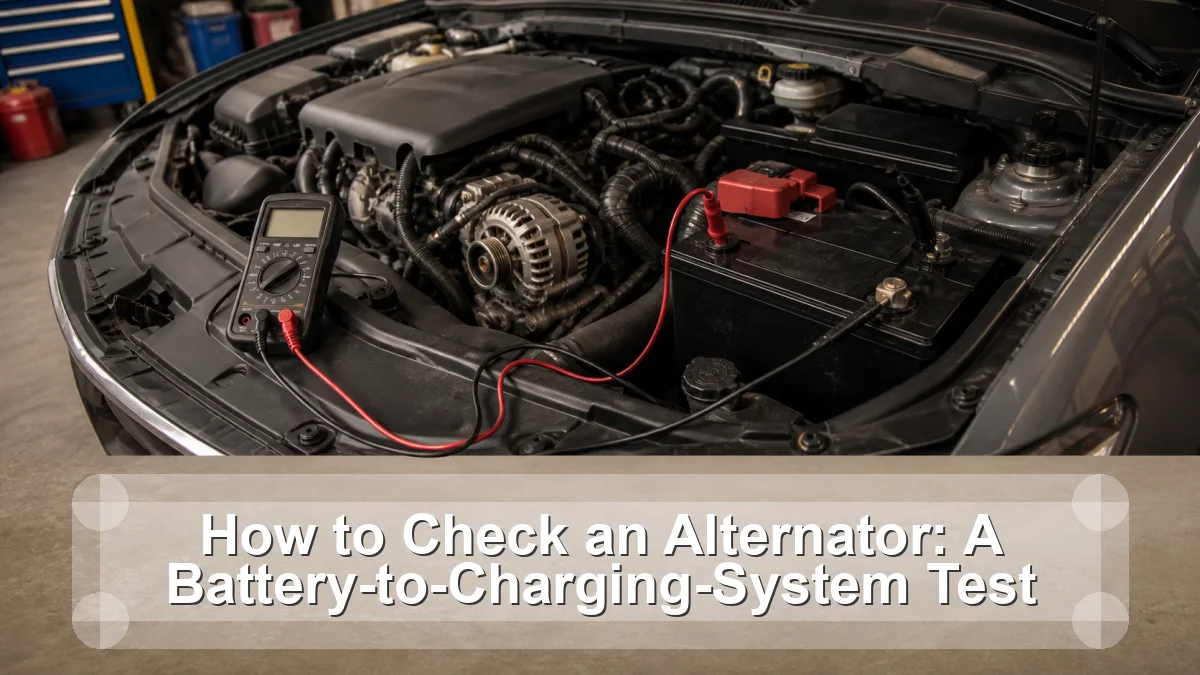
Check the battery first, then inspect the belt and connections, and only then compare engine-off and engine-running voltage. A single number does not condemn an alternator because smart-charging systems vary their output and a weak battery, loose belt, poor ground, blown fuse, or wiring voltage drop can produce the same complaint.
This guide is a diagnosis and decision aid for a home-garage owner, not a claim that one symptom proves one failed part. Vehicle design, service limits, warning behavior, and test conditions vary, so the exact owner manual and service information remain the final authority.
Read the pattern before choosing a part
The fastest useful move is to describe what changed, when it happens, and what does not happen. The table below is a triage card: it narrows the next check but deliberately avoids turning a clue into a verdict.
| What you notice | What it suggests | Best next move |
|---|---|---|
| Battery is low before starting | Charge and test the battery first | Alternator results will be misleading |
| Voltage rises after startup | Charging system is responding | Output still needs context under load |
| Voltage stays near resting level | No useful charge is reaching the battery | Check belt, fuse, cable, ground, and command |
| Lights brighten and dim with engine speed | Output or connection may be unstable | Do not assume the alternator alone |
| Battery lamp is on | The charging system logged a problem | Scan data and wiring checks matter |
Use several matching clues. One reading, one noise, or one dashboard lamp can be affected by temperature, recent service, battery state, road conditions, or the way the vehicle’s control system is designed.
A practical check sequence
- Identify the system. Read the owner manual and service information. Hybrids, stop-start vehicles, externally regulated systems, and smart alternators do not all behave like a conventional fixed-output setup.
- Make the area safe. Park, set the brake, keep jewelry and tools away from the battery, and inspect for a swollen, cracked, leaking, or frozen battery. Do not test a visibly damaged battery.
- Establish battery state. Let surface charge settle, measure at the posts, and recharge a low battery with a compatible charger. An open-circuit voltage check estimates state of charge; it is not a load or capacity test.
- Observe charging response. Start the engine, note the dashboard lamp, and compare the reading as headlights and blower are switched on. Look for a sensible response rather than chasing one universal target.
- Escalate logically. If charging is absent or unstable, check the belt, main fuse or fusible link, battery cables, grounds, alternator connector, and scan-tool charging command before authorizing replacement.
Write the observations down. A short record of conditions, readings, warning lamps, and recent work is more valuable to a technician than a replacement-part theory. If a test requires bypassing a safety system, opening a pressurized circuit, working near moving parts, or lifting beyond your equipment, stop at the observation stage.
Battery-to-alternator test sequence with voltage-context worksheet
The table and ordered checks above form the article’s working value object. To use it, circle the row that most closely matches the complaint, complete the next check, then revise the hypothesis. A result that contradicts the first guess is progress: it prevents a good component from being replaced and keeps the real fault visible.
Add three lines to the worksheet: conditions (cold, hot, wet, speed, load), evidence (measurement, code, wear, leak, sound), and decision (safe to monitor, book inspection, or stop and tow). That simple structure makes the diagnosis repeatable without pretending every vehicle shares one specification.
Common wrong turns
The tempting shortcut
Disconnecting a battery cable while the engine runs can damage electronics and is not a valid modern alternator test. A safe repair plan should explain both the failed condition and the evidence that ruled out its closest look-alikes.
The misleading assumption
Calling the alternator bad from one low reading ignores battery state and voltage drop. A safe repair plan should explain both the failed condition and the evidence that ruled out its closest look-alikes.
The incomplete repair
Reaching near a moving belt or fan turns a simple electrical check into an injury risk. A safe repair plan should explain both the failed condition and the evidence that ruled out its closest look-alikes.
When to stop
Stop the test for battery swelling, leaking electrolyte, smoke, a hot cable, a burning odor, severe belt damage, or rapidly fluctuating system voltage. Shut the engine off before touching a connector or belt area. If the vehicle needs to be driven with the battery warning lamp on, assume it may stall when stored energy is exhausted and arrange service instead.
When the decision is “stop,” do not let schedule or convenience turn it back into “drive carefully.” Secure the vehicle away from traffic, use hazard warnings where appropriate, and arrange roadside or workshop help. Safety-critical faults can change faster than a symptom list suggests.
Related guides
These links are selected for the next safe decision rather than for keyword repetition. They cover the closest supporting check, tool, or workshop-safety step available before this article’s publication date.
Frequently asked questions
Is 14 volts always required?
No. Conventional systems often charge in that neighborhood, but temperature compensation and computer-controlled charging can move the target. The exact specification and test conditions come from service information.
Can a good alternator charge a dead battery?
It may restore some charge, but an alternator is not a substitute for a controlled battery charger. Deeply discharged or damaged batteries can overload the system and still fail a capacity test.
Does a battery light prove the alternator failed?
No. The lamp identifies a charging-system problem. A belt, fuse, cable, ground, regulator command, battery, or alternator fault can trigger it.
Sources
- Fluke: measuring automotive battery voltage with a multimeter
- HELLA Tech World: starting-system diagnosis and starter checks
Bottom line: Check the battery first, then inspect the belt and connections, and only then compare engine-off and engine-running voltage. A single number does not condemn an alternator because smart-charging systems vary their output and a weak battery, loose belt, poor ground, blown fuse, or wiring voltage drop can produce the same complaint. Use the evidence path, respect the stop conditions, and confirm the exact repair against vehicle-specific information.