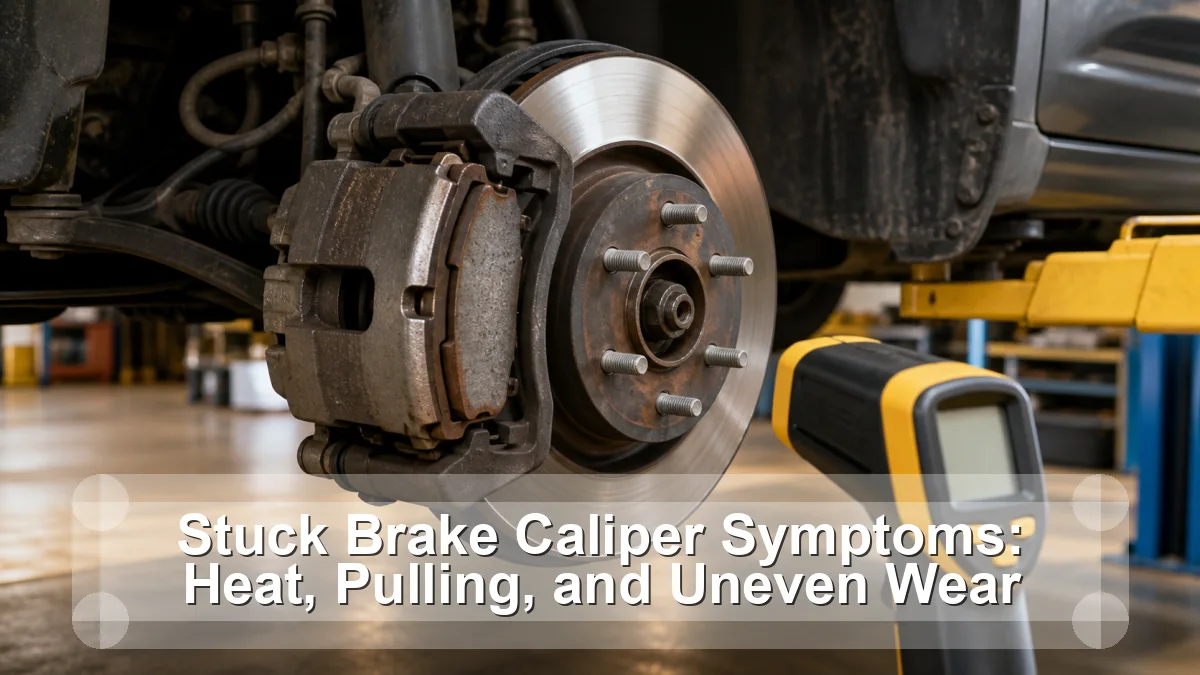
A sticking caliper can make the car pull, feel sluggish, smell hot, show one wheel with abnormal heat, or wear the inner and outer pads unevenly. A collapsed hose, seized slide, rust-bound pad, wheel bearing, parking-brake mechanism, and tire fault can mimic parts of that pattern, so temperature alone is not a parts diagnosis.
This guide is a diagnosis and decision aid for a home-garage owner, not a claim that one symptom proves one failed part. Vehicle design, service limits, warning behavior, and test conditions vary, so the exact owner manual and service information remain the final authority.
Read the pattern before choosing a part
The fastest useful move is to describe what changed, when it happens, and what does not happen. The table below is a triage card: it narrows the next check but deliberately avoids turning a clue into a verdict.
| What you notice | What it suggests | Best next move |
|---|---|---|
| One wheel much hotter | Brake drag is possible | Bearing and drive effects also matter |
| Inner pad worn much faster | Slide or piston movement issue | Inspect hardware and caliper |
| Pull occurs without braking | Continuous drag or tire issue | Compare heat and rolling resistance |
| Pull occurs only while braking | Unequal brake force | Caliper, hose, pad, rotor, tire |
| Pedal releases but wheel stays tight | Hydraulic or mechanical trap | Open-circuit tests by technician |
Use several matching clues. One reading, one noise, or one dashboard lamp can be affected by temperature, recent service, battery state, road conditions, or the way the vehicle’s control system is designed.
A practical check sequence
- Record when it pulls. Note braking, cruising, acceleration, speed, odor, fuel economy, and recent brake work. A timing pattern separates drag from unequal application.
- Let heat dissipate. Park away from combustibles and do not touch the wheel. An infrared reading can compare corners but emissivity and driving conditions affect numbers.
- Inspect wear evidence. With safe lifting, compare inner and outer pads, rotor color, dust, slide boots, hose routing, and parking-brake mechanism.
- Separate mechanical from hydraulic. A technician can determine whether releasing hydraulic pressure frees the wheel, then trace a trapped-pressure cause without guessing.
- Repair the system. Correct the piston, slides, pad fit, hose, cable, or control fault; replace heat-damaged friction parts as needed and verify free rotation and braking balance.
Write the observations down. A short record of conditions, readings, warning lamps, and recent work is more valuable to a technician than a replacement-part theory. If a test requires bypassing a safety system, opening a pressurized circuit, working near moving parts, or lifting beyond your equipment, stop at the observation stage.
Heat-pull-pad-wear confirmation matrix
The table and ordered checks above form the article’s working value object. To use it, circle the row that most closely matches the complaint, complete the next check, then revise the hypothesis. A result that contradicts the first guess is progress: it prevents a good component from being replaced and keeps the real fault visible.
Add three lines to the worksheet: conditions (cold, hot, wet, speed, load), evidence (measurement, code, wear, leak, sound), and decision (safe to monitor, book inspection, or stop and tow). That simple structure makes the diagnosis repeatable without pretending every vehicle shares one specification.
Common wrong turns
The tempting shortcut
Pouring water on an overheated rotor can crack or distort parts. A safe repair plan should explain both the failed condition and the evidence that ruled out its closest look-alikes.
The misleading assumption
Lubricating friction surfaces or using the wrong grease creates a new brake hazard. A safe repair plan should explain both the failed condition and the evidence that ruled out its closest look-alikes.
The incomplete repair
Replacing only one worn pad without finding why it wore unevenly leaves an incomplete repair. A safe repair plan should explain both the failed condition and the evidence that ruled out its closest look-alikes.
When to stop
Stop immediately for smoke, burning odor, severe pull, a glowing rotor, boiling-fluid symptoms, or a wheel that will not rotate freely. Do not continue driving to cool it with airflow. Tow the vehicle after it is safe to handle.
When the decision is “stop,” do not let schedule or convenience turn it back into “drive carefully.” Secure the vehicle away from traffic, use hazard warnings where appropriate, and arrange roadside or workshop help. Safety-critical faults can change faster than a symptom list suggests.
Related guides
- Brake Fluid Leak? Find the Source and Stop Driving Safely
- Steering Wheel Vibration: Match the Shake to the Likely Cause
- Floor Jack Safety Checklist
These links are selected for the next safe decision rather than for keyword repetition. They cover the closest supporting check, tool, or workshop-safety step available before this article’s publication date.
Frequently asked questions
Can a bad brake hose act like a stuck caliper?
Yes. An internally restricted hose can allow pressure in but delay its release. External appearance alone may not reveal it.
Will a stuck caliper always make the wheel hot?
Often, but intermittent faults and short trips may not. Tire pressure, bearing heat, and drivetrain layout complicate comparisons.
Can I replace only one caliper?
Vehicle condition and manufacturer guidance decide. Both sides must be inspected, and friction parts are generally serviced symmetrically by axle.
Sources
- California Bureau of Automotive Repair: brake inspection and diagnosis handbook
- AutoZone: sticking-caliper symptom and cause overview
Bottom line: A sticking caliper can make the car pull, feel sluggish, smell hot, show one wheel with abnormal heat, or wear the inner and outer pads unevenly. A collapsed hose, seized slide, rust-bound pad, wheel bearing, parking-brake mechanism, and tire fault can mimic parts of that pattern, so temperature alone is not a parts diagnosis. Use the evidence path, respect the stop conditions, and confirm the exact repair against vehicle-specific information.