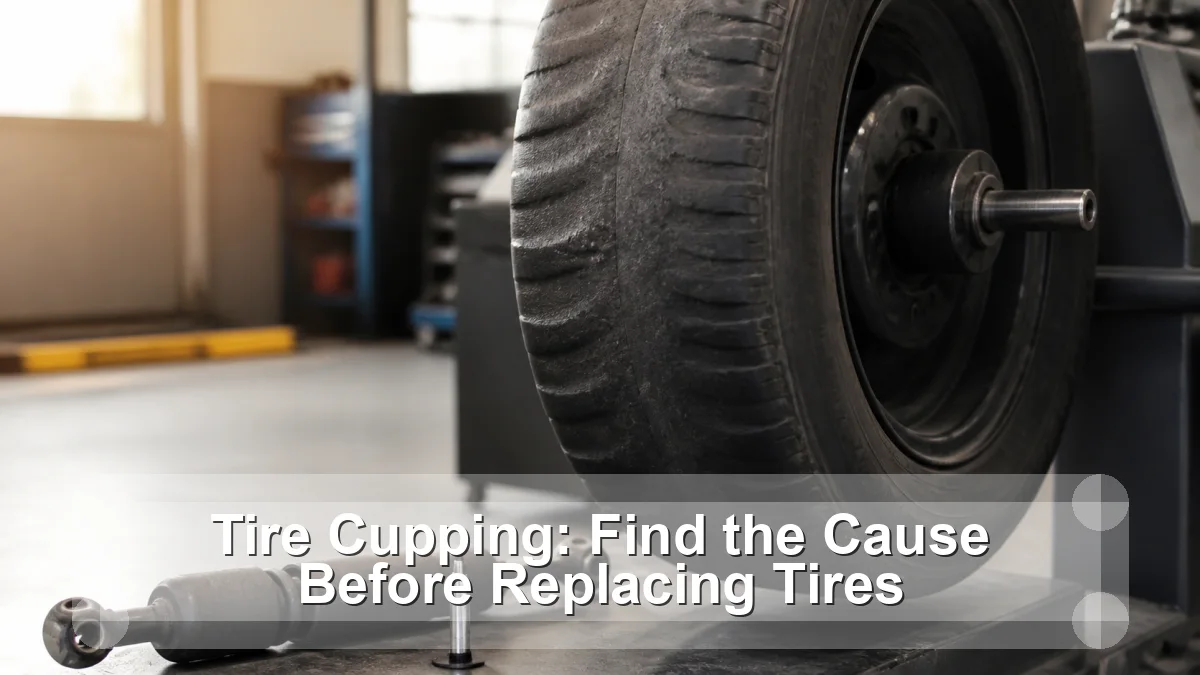
Cupping is a repeating high-low or scalloped wear pattern. The lost tread cannot be restored; the repair is to diagnose and correct the cause—often wheel/tire imbalance or runout, worn shocks or struts, looseness, alignment, pressure, or damage—then decide whether the tire remains serviceable.
This guide is a diagnosis and decision aid for a home-garage owner, not a claim that one symptom proves one failed part. Vehicle design, service limits, warning behavior, and test conditions vary, so the exact owner manual and service information remain the final authority.
What the clues actually tell you
The fastest useful move is to describe what changed, when it happens, and what does not happen. The table below is a triage card: it narrows the next check but deliberately avoids turning a clue into a verdict.
| What you notice | What it suggests | Best next move |
|---|---|---|
| Evenly spaced dips around tread | Cupping/scalloping fits | Balance, runout, damping checks |
| Feathered ribs across width | Toe is more likely | Alignment and loose-parts inspection |
| Both shoulders worn | Chronic underinflation possible | Pressure history and damage check |
| One tire only after impact | Wheel/tire damage or local component | Measure that corner |
| Noise changes after rotation | Wear pattern moved with tire | Tire is a major source |
Use several matching clues. One reading, one noise, or one dashboard lamp can be affected by temperature, recent service, battery state, road conditions, or the way the vehicle’s control system is designed.
Work through the evidence in this order
- Confirm the pattern. Use light and a tread gauge. Photograph and measure the high and low spots rather than relying only on road noise.
- Check basic tire conditions. Set pressure, look for age and damage, verify matching size and load, inspect lost weights, and review rotation and impact history.
- Measure wheel-tire behavior. Balance, radial and lateral runout, road force, hub cleanliness, centering, and bent wheels can create repeated loading.
- Inspect the chassis. Check shocks or struts, bushings, ball joints, tie rods, bearings, springs, ride height, and alignment. Replace parts only when evidence shows wear.
- Decide tire fate. Correction may stop new damage but will not regrow tread. Replace tires that are noisy, below limits, damaged, structurally suspect, or too irregular for safe service.
Write the observations down. A short record of conditions, readings, warning lamps, and recent work is more valuable to a technician than a replacement-part theory. If a test requires bypassing a safety system, opening a pressurized circuit, working near moving parts, or lifting beyond your equipment, stop at the observation stage.
Scallop-pattern root-cause inspection matrix
The table and ordered checks above form the article’s working value object. To use it, circle the row that most closely matches the complaint, complete the next check, then revise the hypothesis. A result that contradicts the first guess is progress: it prevents a good component from being replaced and keeps the real fault visible.
Add three lines to the worksheet: conditions (cold, hot, wet, speed, load), evidence (measurement, code, wear, leak, sound), and decision (safe to monitor, book inspection, or stop and tow). That simple structure makes the diagnosis repeatable without pretending every vehicle shares one specification.
Common wrong turns
The tempting shortcut
An alignment alone will not correct imbalance or a weak damper. A safe repair plan should explain both the failed condition and the evidence that ruled out its closest look-alikes.
The misleading assumption
Rotating severely cupped tires can move the noise without solving the cause. A safe repair plan should explain both the failed condition and the evidence that ruled out its closest look-alikes.
The incomplete repair
Installing new tires before checking runout and looseness can repeat the wear quickly. A safe repair plan should explain both the failed condition and the evidence that ruled out its closest look-alikes.
When to stop
Stop driving for exposed reinforcement, a bulge, tread separation, severe vibration, wheel looseness, or a tire that will not hold pressure. Use proper stands or a professional lift for suspension inspection; a floor jack alone is never support.
When the decision is “stop,” do not let schedule or convenience turn it back into “drive carefully.” Secure the vehicle away from traffic, use hazard warnings where appropriate, and arrange roadside or workshop help. Safety-critical faults can change faster than a symptom list suggests.
Related guides
- Steering Wheel Vibration: Match the Shake to the Likely Cause
- How to Check Wheel Alignment Clues Before Booking Service
- Wheel Bearing Noise: How to Separate It From Tire Noise
These links are selected for the next safe decision rather than for keyword repetition. They cover the closest supporting check, tool, or workshop-safety step available before this article’s publication date.
Frequently asked questions
Can cupped tires become smooth again?
Normal driving does not reliably restore missing rubber. Mild noise may change after the cause is fixed, but structural and tread limits still govern replacement.
Do bad shocks always cause cupping?
No. Weak damping is one cause; imbalance, runout, alignment, looseness, pressure, and damage can create similar patterns.
Will balancing fix the tire?
Balancing may correct an underlying force, but it cannot replace tread already worn away.
Sources
- Bridgestone: tire cupping causes and repair decisions
- NHTSA TireWise: pressure, tread, aging, damage, and TPMS guidance
Bottom line: Cupping is a repeating high-low or scalloped wear pattern. The lost tread cannot be restored; the repair is to diagnose and correct the cause—often wheel/tire imbalance or runout, worn shocks or struts, looseness, alignment, pressure, or damage—then decide whether the tire remains serviceable. Use the evidence path, respect the stop conditions, and confirm the exact repair against vehicle-specific information.