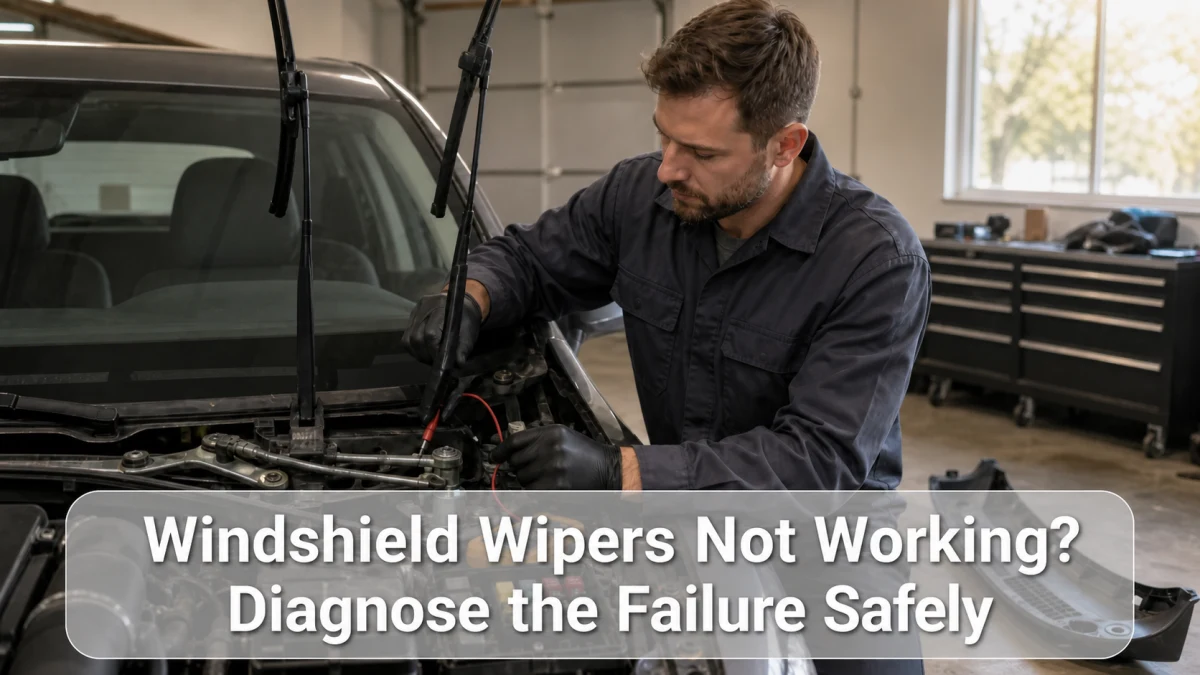
Do not drive into rain, snow, spray, or mud with nonworking windshield wipers. Diagnose the pattern—both arms dead, one arm loose, slow movement, intermittent parking, or blown fuse—then test the fuse, power, ground, switch command, motor, linkage, and mechanical load in order.
Behavior-to-component diagnosis table
| Wiper behavior | Likely areas | Key distinction |
|---|---|---|
| Both front wipers completely dead | Fuse, relay, motor, power, ground, switch, control module | Listen for motor and scan commands |
| Motor runs but arms do not move | Disconnected or stripped linkage | Sound under cowl without arm motion |
| One arm moves; one stays | Loose arm nut, stripped spline, linkage joint | Mark arm position before adjustment |
| Slow or stopping mid-sweep | Ice, binding pivots, weak motor, voltage drop | Measure circuit under load |
| Works on one speed only | Switch, relay, motor winding/contacts, controller | Use exact circuit diagram |
| Will not park correctly | Motor park switch, linkage indexing, controller | Do not reposition arms before diagnosis |
| Intermittent operation | Connector, wiring, switch, control module, motor brushes | Test while symptom is present |
Remove external load first
Free frozen blades from the glass using safe defrosting methods. Clear packed snow, leaves, and heavy debris. Do not pour boiling water on the windshield or force the arms by hand; that can damage glass, splines, linkage, and the motor.
Check that the blades are installed correctly and not caught under trim. A motor protected by a circuit breaker may resume after cooling, but repeated overload still needs repair.
Test the operating pattern
With the windshield wet enough to protect the blades and glass, try mist, low, high, intermittent, and washer-triggered wiping. Note whether the rear wiper works on vehicles that share control logic. Diagnose a no-spray washer fault separately from a wiping fault.
Photograph where the arms stop. If they collide, travel beyond the glass, or sit above their normal park position, switch them off to prevent further damage.
Also record whether the fault began after blade replacement, battery work, freezing weather, or cowl service. That timeline can expose incorrect arm indexing, a loose connector, or an overload event.
Fuse and electrical checks
- Use the owner’s manual or service information to identify the correct fuse or circuit breaker.
- Test both fuse sides electrically; a visual check can miss a small break.
- If it blows again, stop replacing it. The circuit has an overload or short.
- Scan the body control and wiper modules for codes and commanded state where supported.
- At the motor connector, test supply, ground, speed command, and park circuit under load using the correct pinout.
- Perform voltage-drop tests before condemning a motor that receives a weak supply.
Never install a larger fuse. Do not use an unfused jumper or probe airbag-related wiring. Modern wipers may be network-controlled and can move unexpectedly, so isolate power before touching the linkage.
Motor versus linkage
A humming or running motor with stationary arms points toward the crank, linkage, arm splines, or fasteners. Silence does not prove a bad motor because control and supply faults are equally possible. Expose the cowl only by the model-specific procedure; hidden clips, weather seals, washer hoses, and heated-washer wiring can be damaged.
With power isolated, inspect pivots and joints for separation, corrosion, or binding. Do not put fingers into the linkage path. A motor can deliver enough force to cause serious injury.
Park-switch clues
The motor or control system continues operation until the blades reach their park position. Wipers that stop immediately wherever the switch is turned off, cycle continuously, or park in the wrong location may have a park-circuit, indexing, switch, or controller problem. Repositioning the arms can hide the symptom and cause them to strike the cowl.
If the blades move but no fluid reaches the glass, use the windshield-washer no-spray diagnostic guide to separate pump, fluid, hose and nozzle problems from wiper-mechanism faults.
Repair and verification
Replace only the component proven faulty. Correct water intrusion or a blocked cowl drain that damaged a connector or motor. Torque arm fasteners to service data and index the linkage as specified. Test on a wet windshield through all modes, confirm the blades do not collide, and verify proper park.
Carry basic visibility supplies from our car emergency checklist, but do not treat a towel or water repellent as a substitute for working wipers in bad weather.
Frequently asked questions
Can I drive home if the wipers stop?
Only if weather and visibility are fully clear and local law permits; do not enter precipitation or road spray. The safer decision is to park or arrange assistance.
Why did the fuse blow in snow?
Frozen blades or packed snow can overload the motor, but a short, binding linkage, or failing motor can do the same. Remove load and diagnose before fitting another fuse.
Can a bad switch stop both wipers?
Yes, but verify switch command, module input, fuse, relay, power, ground, and motor before replacing it. Steering-column work near airbags should be left to qualified repair.
Sources
Bottom line: protect visibility first, then separate electrical command from mechanical movement. A behavior-based test prevents replacing a motor when the real fault is a fuse, linkage, switch, or power path.