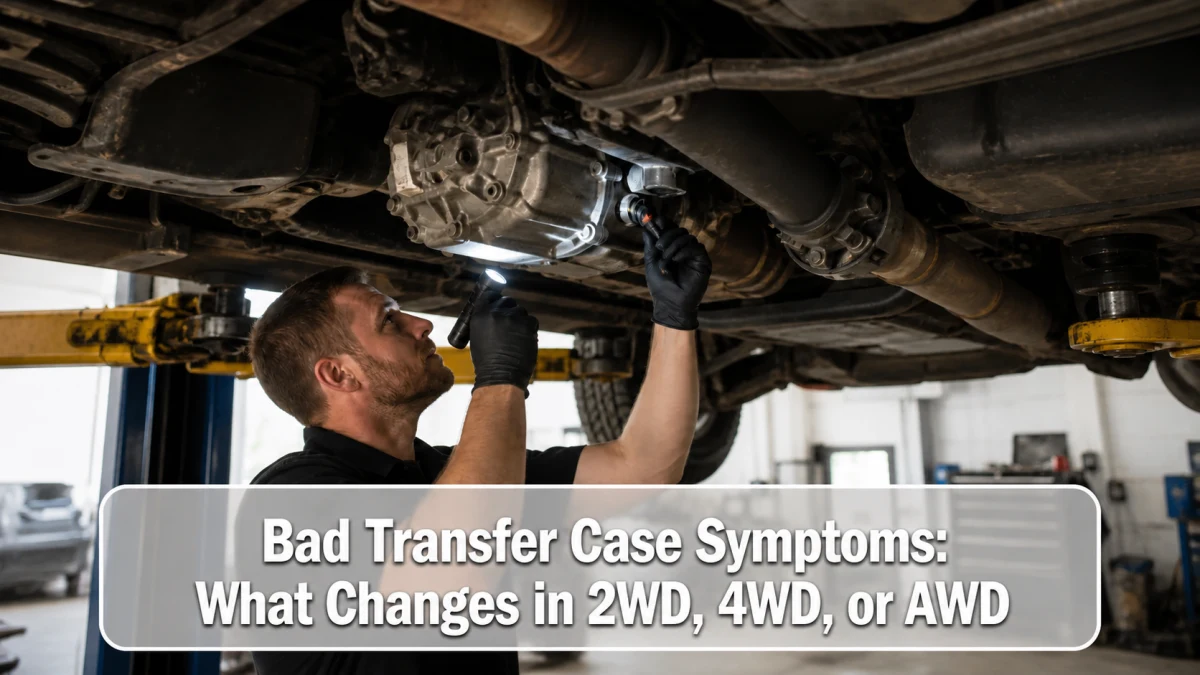
A failing transfer case may leak, whine, grind, bind, refuse a selected range, show a 4WD warning, or behave differently in 2WD, 4WD, or AWD operation. Those symptoms overlap with tires, wheel bearings, driveshafts, axles, differentials, transmission faults, and incorrect mode use. Start with architecture, tire match, fluid, codes, and when the symptom changes.
What the transfer case does
A transfer case sends transmission output to front and rear driveline components. Part-time 4WD may lock front and rear speeds together. Full-time systems can use a center differential, clutch pack, viscous coupling, or electronically controlled unit. Low range adds reduction on equipped vehicles.
Because designs differ, a behavior that is normal for one system can indicate misuse or failure in another. The owner’s manual determines whether a mode is allowed on dry pavement.
Drive-mode symptom comparison
| Pattern | Transfer-case direction | Important look-alikes |
|---|---|---|
| Noise in every mode and speed | Bearing, chain, gear, fluid, output | Transmission, wheel bearing, driveshaft, differential |
| Noise only when 4WD engaged | Front output, actuator, chain/load path | Front axle, CV joints, differential |
| Binding in tight dry turns | Part-time mode misuse or clutch not releasing | Tire size/pressure mismatch, differential issue |
| Will not shift range | Actuator, sensor, control, linkage, internal fork | Incorrect stop/neutral procedure or low voltage |
| 4WD warning after tire replacement | Clutch/load protection or calibration | Mismatched circumference or wheel-speed input |
| Clunk on acceleration/coast | Chain, mount, spline, internal lash | U-joint, CV joint, differential, transmission mount |
Binding versus normal locked behavior
Part-time 4WD often connects axles without allowing enough speed difference for tight turns on high-traction pavement. Driveline wind-up can cause hopping, heavy steering, or refusal to disengage. Shift back using the manual’s method and use that mode only on the permitted loose or slippery surface.
If an AWD or full-time system binds on ordinary turns, check tire circumference, clutch control, fluid, sensor data, and internal operation. Do not continue forcing tight turns.
Tire mismatch can imitate failure
Different model tires, sizes, tread depths, or pressures rotate at different rates. Some systems interpret that as slip and work a coupling continuously, creating heat, warnings, or binding. Measure and compare all four tires against the manufacturer’s replacement limits; sidewall size alone does not prove equal rolling circumference.
Fluid and leak clues
Inspect the case halves, drain and fill plugs, actuator seals, vent, and input/output seals for the highest wet point. Fluid can arrive from the transmission or travel along a driveshaft. Use the fluid-identification guide, knowing that some transfer cases use ATF while others use gear oil or a dedicated fluid.
Never substitute fluid by appearance. Check level and fill procedure with the vehicle level and at the stated conditions. A blocked vent or worn bearing can cause a replacement seal to leak again.
Electrical and actuator diagnosis
- Verify battery and charging voltage because low voltage can interrupt range shifts.
- Scan transfer-case, transmission, ABS, and powertrain modules for codes.
- Compare requested mode, encoder position, wheel speeds, clutch command, and temperature data where available.
- Inspect connectors and harnesses near heat, water, and moving shafts.
- Perform actuator calibration or functional tests only as service information directs.
- Confirm mechanical linkage and internal movement before replacing a controller.
A blinking 4WD lamp can mean a shift is still in progress, conditions are not met, or a fault exists. Do not cycle the switch repeatedly without reading the manual and codes.
Noise diagnosis
A chain-related rattle may change with load, while bearings often follow vehicle speed. Driveshaft joints can squeak or clunk, and wheel bearings can change during turns. Chassis microphones, lift inspection, fluid debris, and shaft-play measurements help locate the sound. Generic listening while running on stands is dangerous and may defeat stability systems.
Repair urgency
Stop driving for grinding, case damage, rapid fluid loss, a shaft or joint with dangerous play, inability to disengage a binding mode, or a drivetrain warning accompanied by abnormal operation. A tow prevents a seized component or detached shaft from causing wider damage.
If underbody access is required, use approved lift points and the floor-jack safety checklist. Service the rear axle separately according to the rear differential fluid interval guide; the transfer case and differential do not automatically share fluid or schedules.
Frequently asked questions
Can I drive in 4WD on dry pavement?
Only if the owner’s manual says that selected mode is designed for high-traction surfaces. Part-time locked modes commonly are not.
Will changing transfer case fluid fix a warning?
Correct fluid and level matter, but codes, tire mismatch, actuators, sensors, clutches, and mechanical wear may remain. Diagnose before treating fluid service as a repair.
Can one new tire damage an AWD system?
Excess circumference difference can stress some systems. Follow the manufacturer’s tread-depth and matching rules rather than assuming one replacement is acceptable.
Sources
- NHTSA-hosted bulletin: vehicle-specific transfer-case diagnosis example
- NHTSA-hosted bulletin: additional transfer-case fault example
- CarParts: transfer case symptom overview
Bottom line: compare mode behavior, tire circumference, fluid evidence, and module data. Transfer-case diagnosis begins with understanding the system—not assuming every AWD clunk or bind comes from the case.