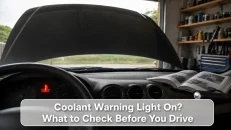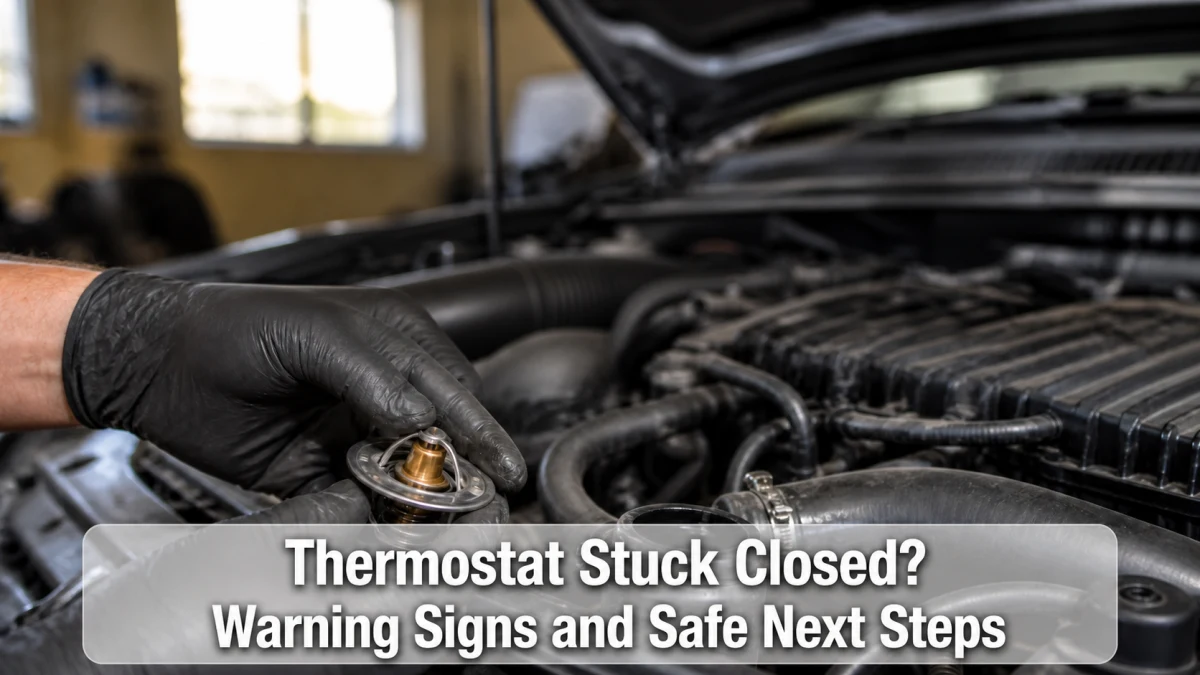
A thermostat stuck closed can stop hot coolant from reaching the radiator. The warning pattern is a temperature gauge climbing quickly, little or no radiator heat transfer, and possible steam or coolant loss. If the gauge enters the hot zone or a red temperature warning appears, turn off the air conditioning, pull over safely, shut the engine down, and do not open the cooling system while it is hot.
What happens when the thermostat stays closed
The thermostat normally opens as the engine warms, allowing coolant to circulate through the radiator. If it remains closed, heat becomes trapped in the engine-side circuit. The radiator cannot remove heat at the expected rate, so temperature can rise rapidly.
This is not the only cause of overheating. Low coolant, a failed water pump, an air pocket, blocked airflow, a nonworking fan, a restricted radiator, or a faulty temperature signal can create a similar dashboard warning. Diagnosis should follow the system, not the most familiar part name.
Stuck open versus stuck closed
| Clue | More consistent with stuck open | More consistent with stuck closed |
|---|---|---|
| Warm-up | Slower than usual | Normal at first, then rapidly too hot |
| Cabin heat | Often weak | May become very hot, fluctuate, or disappear if coolant is low or boiling |
| Highway behavior | Temperature may drop | Temperature usually continues rising |
| Radiator heat | May warm too early | May stay comparatively cool while the engine overheats |
| Immediate risk | Usually lower | High; continued driving can cause severe damage |
These are patterns, not confirmation tests. Cooling-system layouts and gauge behavior differ by vehicle.
What to do when temperature starts climbing
- Move out of traffic. Choose a safe place to stop rather than trying to reach home.
- Shut the engine off. Continuing to drive removes your remaining safety margin.
- Keep the cap closed. A hot pressurized system can discharge scalding coolant. Waiting until the gauge drops is not proof that pressure is gone.
- Look from a distance. Note steam, dripping coolant, a collapsed hose, or debris blocking the radiator, but do not reach near fans or belts.
- Arrange a tow when warning signs were severe. Restarting an engine that has steamed, lost coolant, or pegged the gauge is a poor diagnostic experiment.
Safe checks after the engine is completely cold
Use the owner’s manual to identify the reservoir, correct coolant, and cold-level marks. If the level is low, finding the leak matters more than topping up and continuing. Check the belt where it drives a mechanical water pump, inspect hoses for obvious damage, and look for dried coolant residue.
A scan tool can help determine whether the reported coolant temperature rises smoothly and plausibly. An implausible signal or sudden jump may point toward the sensor circuit. HELLA’s diagnostic sequence also checks fan operation, radiator airflow, thermostat opening, radiator flow, the water pump, and cap function.
What a shop may test
- Cooling-system pressure and visible leaks when cold
- Temperature before and after the thermostat
- Radiator inlet-to-outlet temperature pattern
- Cooling-fan command and actual operation
- Water-pump circulation
- Coolant-temperature sensor plausibility
- Combustion-gas or leak-down evidence when an internal engine leak is suspected
Removing a thermostat and heating it in water is sometimes part of service diagnosis, but the opening specification and safe procedure are vehicle-specific. Many modern thermostats are integrated into plastic housings or electronically controlled assemblies.
Can you drive with a thermostat stuck closed?
Do not plan to drive a car that is overheating because coolant circulation is blocked. The distance to the shop is not a reliable safety measure; temperature can move from acceptable to damaging quickly. Towing is cheaper than risking cylinder-head, gasket, piston, or catalytic-converter damage.
Repair without creating a second problem
Use the exact thermostat or housing specified for the vehicle. Follow the manufacturer’s sealing, torque, refill, and air-bleeding instructions. Mixing incompatible coolants, reusing a distorted seal, or leaving trapped air can cause a new overheating complaint immediately after the repair.
If access requires the vehicle to be raised, first identify the correct jacking points and follow the floor-jack safety checklist.
Frequently asked questions
Will turning the heater on save an overheating engine?
The heater can remove a limited amount of heat only when hot coolant is circulating through the heater core. It is not a repair and should not be used to justify continued driving.
Can a bad sensor imitate a stuck-closed thermostat?
Yes. A biased sensor, wiring fault, or gauge problem can report an incorrect temperature. Steam, coolant loss, or other physical overheating evidence makes the situation urgent regardless of the display’s cause.
Why did the cabin heat suddenly turn cold while the gauge rose?
Low coolant, boiling, an air pocket, or lost circulation can stop the heater core from receiving liquid coolant. Shut the engine down and investigate after it is fully cold.
Sources
Bottom line: rapid overheating is a stop-driving problem. A closed thermostat is one possibility, but coolant level, circulation, airflow, fan control, and sensor accuracy all need to be checked.