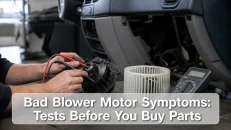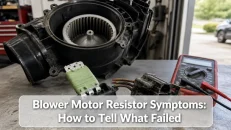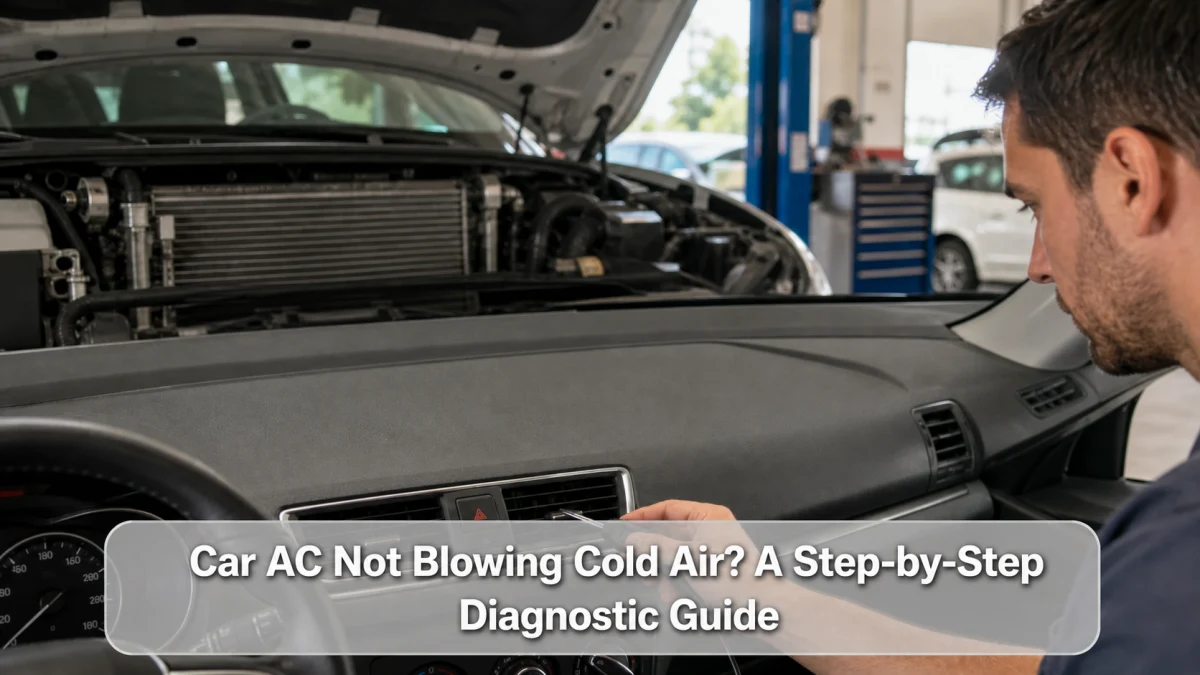
When a car’s AC blows air but it is not cold, start by separating an airflow problem from a cooling problem. Weak air points toward the cabin filter, blower, ducts, or evaporator airflow. Strong air that stays warm points more toward compressor operation, refrigerant charge, condenser airflow, sensors, or a temperature-blend door.
First decide: weak airflow or warm airflow?
This split prevents a common mistake—adding refrigerant to a system that cannot move enough cabin air.
| What the vents do | Likely area to investigate | Useful next observation |
|---|---|---|
| Air is weak at every temperature setting | Cabin filter, blower motor, resistor/module, evaporator restriction, duct door | Do fan speeds and vent modes change normally? |
| Air is strong but never cools | Compressor control, refrigerant charge, sensor, blend door | Does temperature change at road speed? |
| Cold while moving, warm at idle | Condenser airflow or cooling-fan operation | Does the electric fan operate when commanded? |
| Cold at first, then warm | Evaporator icing, sensor fault, compressor control, airflow restriction | Does airflow also fade before cooling disappears? |
| One side cold, one side warm | Dual-zone door/actuator, sensor, or charge-distribution issue | Do left and right controls respond? |
Check the controls before the components
Use a repeatable setup: engine running outdoors, windows initially open to release trapped heat, temperature at its coldest setting, AC on, and recirculation off for the first comparison. Confirm that the display accepts the command and that air exits the selected vents.
On automatic climate systems, extreme cabin temperature and sun load can change blower speed and outlet choice. Read the owner’s manual before treating normal automatic behavior as a fault.
Look at airflow through both heat exchangers
Cabin side
A packed cabin filter can reduce air reaching the evaporator. Replace it only with the correct airflow orientation. Leaves in the intake, a weak blower, or a door that does not reach its commanded position can create the same complaint.
Condenser side
The condenser releases cabin heat at the front of the vehicle. Debris can restrict it, and a failed electric fan may explain why AC improves at speed. Inspect from a safe distance. Fans can start automatically, and forcing water through delicate fins at high pressure can damage them.
What compressor behavior can tell you
Older systems may have a visible clutch that engages and disengages. Many newer compressors use variable displacement, clutchless designs, or electric drive, so the absence of a familiar “click” proves little. The control module may withhold compressor operation because of low or high pressure, engine temperature, battery voltage, a sensor fault, or another protective condition.
Do not bypass pressure switches or jump connectors. That can command a compressor without confirming lubrication or system pressure.
Could it be low on refrigerant?
Yes, but refrigerant is not consumed like fuel. A low charge normally means refrigerant escaped through a leak or during previous service. EPA notes that topping off or recharging can restore cooling temporarily, but neither permanently repairs a leak.
Pressure on a single low-side gauge is not enough to determine the correct charge. Ambient temperature, blower airflow, compressor design, engine speed, and system controls all affect the reading. The accurate service method identifies the refrigerant, recovers what remains with approved equipment, repairs leaks as appropriate, evacuates the system, and charges the specified mass.
Temperature-blend door clues
A blend door controls how much air passes through the heater side of the HVAC case. If its actuator, linkage, or door fails, the vents can remain warm even when the refrigeration loop is working. Clicking behind the dash, a temperature that does not respond to the control, or different left-right temperatures can point in this direction.
When to stop the driveway checks
- Visible oily residue is concentrated at an AC fitting or component.
- A fuse fails again after replacement.
- Wiring, a connector, or the blower resistor shows melting.
- The compressor makes grinding or severe rattling noises.
- The vehicle uses high-voltage electric AC components.
- You need to recover, evacuate, identify, or charge refrigerant.
EPA requires technicians who service motor-vehicle AC systems for compensation to hold Section 609 certification and use approved equipment. Even for personal work, refrigerant type, pressure, flammability, environmental rules, and protective equipment make professional service the sensible boundary for opening the system.
If under-vehicle access is part of a visual inspection, use the correct jacking points and the site’s lifting safety checklist.
Frequently asked questions
Why is the AC cold only while driving?
Road speed increases air through the condenser. A weak or inoperative fan, blocked condenser, or control problem becomes more likely, although refrigerant and compressor issues remain possible.
Will a recharge kit fix warm AC?
It may temporarily change cooling if the charge is low, but it cannot identify the leak or establish the correct refrigerant mass. Overcharging and mixing refrigerants can create additional problems.
Why did cooling disappear after a battery repair?
A fuse, connector, stored fault, lost actuator calibration, or unrelated timing can be involved. Check the owner’s manual and scan for relevant faults rather than assuming refrigerant escaped.
Sources
- US EPA: motor-vehicle AC servicing information
- US EPA: leak repair and recharge options
- AutoZone: AC problem diagnosis overview
Bottom line: diagnose airflow first, then compare idle and road-speed cooling, fan operation, compressor control, and blend-door response. Treat a low refrigerant charge as evidence to find a leak—not as routine consumption.