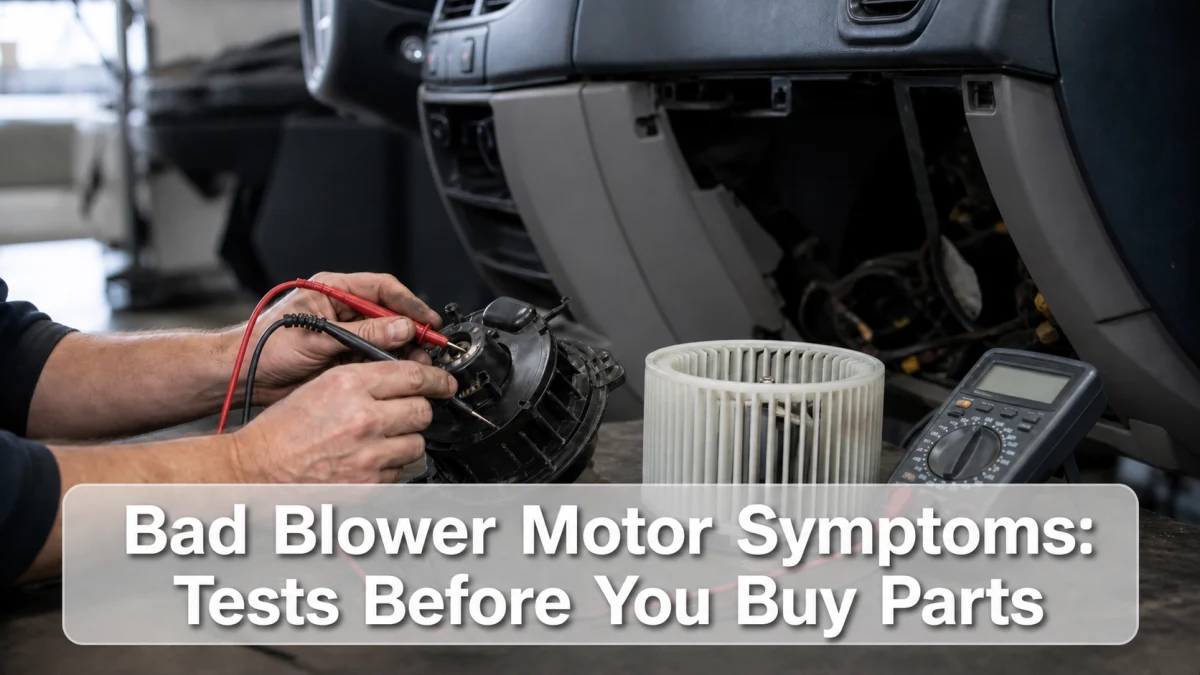
A bad blower motor may be silent, intermittent, noisy, slow, or able to start only after vibration. The same no-airflow complaint can come from a fuse, relay, resistor or control module, switch, wiring, ground, or blocked fan wheel. Confirm voltage, ground, command, and motor load before ordering a motor.
Symptoms that point toward the motor
A worn motor may stop at certain armature positions, run more slowly as it heats, or draw excessive current. Worn bearings or debris can produce chirping, scraping, or rumbling that follows fan speed. A damaged wheel can vibrate or move little air even though the motor is audible.
Intermittent operation after a bump sometimes points to worn brushes or a loose connector, but striking the dashboard or motor is not a proper test. It can damage trim, the fan wheel, airbag-area parts, or an already fragile connector.
Motor-versus-circuit matrix
| Observation | Possible motor fault | Other likely checks |
|---|---|---|
| No sound on any speed | Open motor or seized motor | Fuse, relay, power, ground, control command |
| High speed works; lower speeds fail | Motor may still be overloaded | Resistor/module and connector |
| Squeal or scrape changes with speed | Bearing, wheel, or debris | Housing contact and inlet obstruction |
| Motor slows after several minutes | Heat-related winding or bearing issue | Voltage drop, control module, connector heat |
| Strong motor sound but weak vent airflow | Loose or damaged wheel | Cabin filter, evaporator, duct, mode door |
| Runs with direct power only | Motor can operate under that test | Vehicle power, ground, relay, and controller |
Begin with airflow and controls
Remove and inspect the cabin filter only as the manual directs. Leaves or rodent nesting can obstruct the inlet or contact the wheel. Verify that the fan command changes on the display and that air direction controls respond. A door fault can send air to the wrong outlet and be mistaken for no blower.
If only certain speeds fail, first read the blower resistor pattern guide. Conventional resistors and electronic control modules fail differently.
Electrical test sequence
- Obtain the wiring diagram, connector views, fuse locations, and expected operating conditions for the exact vehicle.
- Check relevant fuses with a meter or test light on both sides; visual inspection can miss a hairline break.
- Command the blower and scan the HVAC module for codes and live command data where supported.
- Measure voltage across the motor circuit under load. A nearly battery-level open-circuit reading can collapse when current flows.
- Perform voltage-drop checks on power and ground paths using the specified limits.
- Measure motor current with appropriate equipment and compare it with service information.
- If power, ground, and command are correct but the motor does not run or draws abnormal current, the motor becomes the leading fault.
Keep probes and hands clear of a wheel that can start. Do not short terminals with a jumper wire. A fused test lead and the exact connector pin information are essential if a service procedure calls for a direct-power test.
Why direct power is not the first test
Applying power can show whether a two-wire conventional motor spins, but it does not prove normal current draw, bearing condition, or performance when hot. It can also damage an electronically controlled unit if the wrong pins are used. Modern blower assemblies may include control electronics, so follow the manufacturer’s test rather than a generic internet pinout.
Inspect the connector and surrounding circuit
Darkened plastic, melted terminals, or a burnt odor show heat but not the complete cause. Loose terminal tension or excessive motor current can overheat a connector. Repair the terminal or pigtail with the approved parts, and fix the motor or circuit problem that created the load.
A replacement fuse that opens again is evidence of a short or overload. Never fit a higher-amperage fuse. Doing so removes protection from the harness and can create a fire risk.
Noise diagnosis
A tick that speeds up with the fan often comes from a leaf touching the wheel. A rumble may indicate a worn bearing or unbalanced wheel. A squeal can be bearing-related, while a scraping sound may come from a distorted housing or displaced wheel. Inspect with power isolated; the wheel’s condition and clearance matter as much as the sound.
Repair decision and final checks
Replace the motor when tests confirm correct supply and control but it fails to operate, draws outside specification, binds, or produces internal mechanical noise. Clean the inlet, verify the wheel is secure, replace a heavily restricted filter, and repair damaged connectors. After assembly, test all speeds and modes and confirm that no wiring is pinched.
If airflow is strong but the air remains warm, work through the complete AC performance checklist rather than replacing more blower components.
Frequently asked questions
Can a blower motor fail only when hot?
Yes. Winding, brush, bearing, connector, and control faults can change with temperature. Measure the circuit while the complaint is present.
Will a bad blower motor drain the battery?
A motor or stuck control relay can contribute to a draw if it continues running with the vehicle off, but parasitic-drain testing must identify the active circuit before parts are replaced.
Can I lubricate a noisy blower motor?
Many motors are sealed and not designed for field lubrication. Added lubricant can attract debris or reach electrical parts. Follow service information and replace a confirmed worn assembly.
Sources
- NHTSA-hosted Kia technical material: electrical and blower diagnosis examples
- NAPA Know How: common blower motor symptoms
Bottom line: prove that the motor receives usable power, ground, and command under load. Speed patterns, current draw, noise, and connector condition together make a stronger diagnosis than any single symptom.